
Translation note: This article was translated with the assistance of AI.
GKN Aerospace has become the first company worldwide to receive Nadcap accreditation for Laser Wire Directed Energy Deposition (L-DED-w). This additive manufacturing process builds complex metal components layer by layer. Potential aviation applications include larger structures and components made from high-value metal alloys.
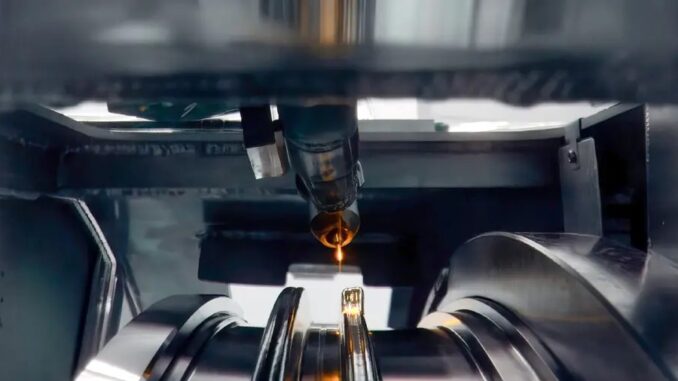
L-DED-w uses a continuous feed of metal wire rather than the metal powder used in powder bed processes. A laser melts the wire as the deposition head lays down successive tracks and layers to form a three-dimensional metal structure. The head’s movement defines the component’s geometry.
L-DED-w is closely related to laser deposition welding: both apply localized heat to melt added metal and form a metallurgical bond with the base material. Conventional welding often serves to join components, while L-DED-w primarily builds new structures. It can also deposit material onto existing components.
Reducing Material Waste in Aircraft Component Manufacturing
Larger metal structures are a potential application in aviation. Conventional production often involves machining aircraft components from solid metal blanks, which can require extensive material removal. Additive manufacturing places material where the component’s final geometry requires it.
For expensive materials such as titanium alloys, this approach can offer economic benefits. It also allows near-net-shape production, followed by machining to obtain the final geometry and surface finish.
Wire-based technology offers advantages over powder bed metal 3D printing when building larger structures and depositing material. Components nevertheless require further processing and inspection before installation in an aircraft.
Airbus Already Uses a Related Process on the A350
Airbus has begun incorporating larger additively manufactured titanium components into the structure around the A350’s cargo door, bringing wire-based additive manufacturing into commercial aviation. The parts replace conventional forgings and are machined to their final geometry after deposition.
These components are made using wire-based Directed Energy Deposition (w-DED). According to Airbus, the process uses plasma to melt the metal; GKN Aerospace uses a laser. The two methods belong to the same technology family, with different energy sources and process characteristics.
Airbus sees particular potential for larger structural components. Longer-term applications could include other highly loaded aircraft components, such as wing structures and landing gear. The parts in service on the A350 show that wire-based metal 3D printing has progressed beyond development alone.
Nadcap Accreditation Supports Industrial Production
GKN Aerospace’s recently awarded Nadcap accreditation marks a further step in industrializing L-DED-w. It confirms that the audited manufacturing processes comply with the requirements of the internationally recognized Nadcap program.
Among the areas audited were process controls, operating procedures, personnel qualifications, equipment, material control, and traceability. Producing safety-critical aerospace components requires reproducible manufacturing conditions and consistent material properties.
GKN Aerospace has experience developing and manufacturing additively produced aircraft components. The company says fully certified additively manufactured parts are already flying. Its latest announcement does not identify which of those parts were made using L-DED-w.
The accreditation supports broader industrial use of L-DED-w. Individual components still require qualification and approval for their respective aircraft programs.
Photo: GKN Aerospace