
Translation note: This article was translated with the assistance of AI.
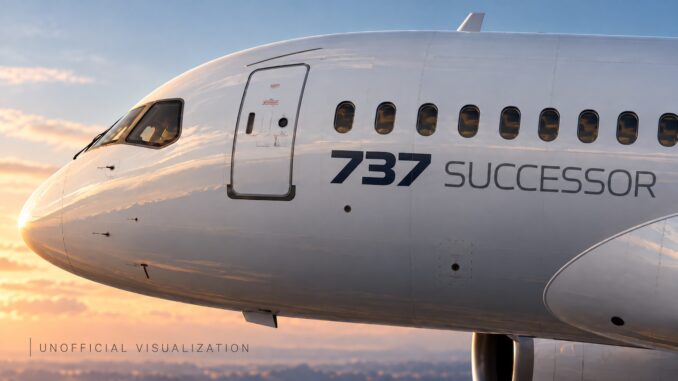
Boeing is already exploring a potential successor to the 737 MAX. In late October 2026, CEO Kelly Ortberg confirmed that a product development team is working to define what a new commercial aircraft might look like and when it could enter the market. Reports also suggest that preliminary discussions with engine manufacturers have taken place. However, Boeing has yet to formally launch a new aircraft program. What technologies could shape its next generation of narrowbody aircraft?
Boeing Confirms Work on a New Aircraft
The Boeing 737 could eventually be replaced by an entirely new aircraft design. During the company’s third-quarter earnings call on October 27, 2026, Boeing CEO Kelly Ortberg confirmed that a product development team is exploring the configuration of a future aircraft and the appropriate timing for its market introduction.
His comments came in response to an analyst’s question about Boeing’s plans for a new narrowbody aircraft. Ortberg emphasized that the company’s position on launching a new aircraft program had not changed. The necessary investments were already factored into Boeing’s long-term financial planning.
Chief Financial Officer Jay Malave also addressed potential development spending. According to Malave, major investments in a new program are not imminent, with the initial focus remaining on research and technology development. As Boeing completes its ongoing development programs, financial and engineering resources could gradually become available for future aircraft projects.
Ortberg’s remarks confirm that Boeing is working on defining a future commercial aircraft. However, the manufacturer has not announced a formal development decision or a specific timeline.
Early Indications of Technical Development
Reports that Boeing was evaluating potential technical solutions had emerged even before Ortberg’s latest comments. In September 2025, The Wall Street Journal reported, citing people familiar with the plans, that Boeing had begun preliminary work on a successor to the 737 MAX.
According to the report, the company had started initial cockpit design work. Ortberg had also reportedly met with representatives of British engine manufacturer Rolls-Royce to discuss a potential powerplant for a new narrowbody aircraft.
Development remains at an early stage. In particular, it is not yet known whether Boeing intends to pursue an entirely new aircraft design or incorporate selected technologies from existing programs.
New Wings and a Different Aircraft Architecture?
One of the most important decisions for a potential 737 successor concerns its overall aircraft architecture. Today’s Boeing 737 MAX belongs to an aircraft family whose origins date back to the 1960s. Although the design has undergone extensive modernization over several generations, certain technical constraints remain rooted in the original configuration.
One of these is the aircraft’s relatively low ground clearance, which complicates the installation of larger engines beneath the wings. During development of the 737 MAX, Boeing therefore positioned the larger LEAP-1B engines farther forward and higher relative to the wing. The nose landing gear was also extended by approximately eight inches (20 centimeters) to maintain adequate ground clearance.
An entirely new aircraft could be designed from the outset around the requirements of modern engines, including larger fan diameters, suitable landing gear geometry, and aerodynamically optimized engine integration.
The wing offers further opportunities for improvement. New airfoil designs, higher aspect ratios, and greater use of composite materials could help reduce aerodynamic drag and structural weight. However, any increase in wingspan would also have to comply with airport infrastructure requirements.
Which Engine Could Power Boeing’s Next Aircraft?
The choice of engine is another important question. Today’s 737 MAX is powered exclusively by the LEAP-1B from CFM International, a joint venture between GE Aerospace and Safran Aircraft Engines.
For a new aircraft, Boeing could consider several advanced engine architectures. Potential candidates include conventional ducted turbofans, particularly geared turbofan designs. These could deliver further efficiency improvements over current engines without requiring the fundamentally different aircraft integration associated with exposed rotors.
A more technically demanding alternative is the Open Fan architecture being developed by CFM International under its RISE program. The concept eliminates the conventional fan duct and aims to significantly reduce fuel consumption compared with today’s engines. However, it also presents challenges involving engine integration, noise, and safety. Additional protective measures and structural modifications could offset some of the anticipated efficiency gains.
According to information published by Aviation Week in 2024, engineers within Boeing’s product development organization had expressed reservations about the Open Fan concept, particularly regarding the additional structural requirements. Nevertheless, Boeing has not ruled out the technology. Boeing Commercial Airplanes CEO Stephanie Pope stated in July 2026 that it was too early to make a decision. Key considerations include fuel consumption and how efficiently the engine can be integrated into the aircraft as a whole.
Rolls-Royce is also developing technologies for future narrowbody engines. With its UltraFan 30 demonstrator, the British manufacturer aims to reenter this market over the longer term. Against this backdrop, the reported discussions between Boeing and Rolls-Royce are particularly noteworthy.
Competition with the Airbus A320 Successor
The development of a new Boeing narrowbody would likely coincide with Airbus’s efforts to develop the next generation of commercial aircraft. The European manufacturer is already investigating new wing designs, propulsion technologies, and manufacturing processes for a potential successor to the A320neo.
Airbus aims to achieve substantial improvements in fuel efficiency with its next aircraft generation. Technologies under consideration include Open Fan engines and advanced ducted turbofans. The company is targeting a potential program launch around 2030.
For Boeing, the key question is when the necessary technologies will offer a sufficiently large improvement over the 737 MAX. A new aircraft would need not only lower fuel consumption but also competitive manufacturing and operating costs.
At the same time, Boeing could use the opportunity to develop a narrowbody aircraft without the design constraints inherited from earlier 737 generations. Which passenger capacity and range segments the company might target remains unknown.
Existing Programs Take Priority
Despite these longer-term considerations, Boeing remains focused on its current development and production programs. These include ramping up 737 MAX production and bringing additional aircraft variants into service.
On October 20, 2026, the 737-10, the largest member of the MAX family, received certification from the Federal Aviation Administration (FAA). The smaller 737-7 had already been certified. First deliveries of both variants are scheduled for 2027.
In parallel, Boeing continues working toward certification of the 777-9, with first delivery also planned for 2027. These programs continue to require substantial engineering and industrial resources.
Boeing is also working to stabilize 737 MAX production at 47 aircraft per month, a target the company expects to achieve in 2027. Following a period of stable production, Boeing plans to increase the rate further to 52 aircraft per month. Given the substantial order backlog, the existing 737 family is likely to remain an important part of Boeing’s commercial aircraft portfolio for years to come.
When Boeing might actually bring a successor to market remains uncertain. Nevertheless, Kelly Ortberg’s latest statements confirm that the company is already examining the fundamental requirements for a future commercial aircraft. Whether these efforts ultimately lead to an entirely new narrowbody program will depend on technological progress, market demand, and the availability of development resources.