
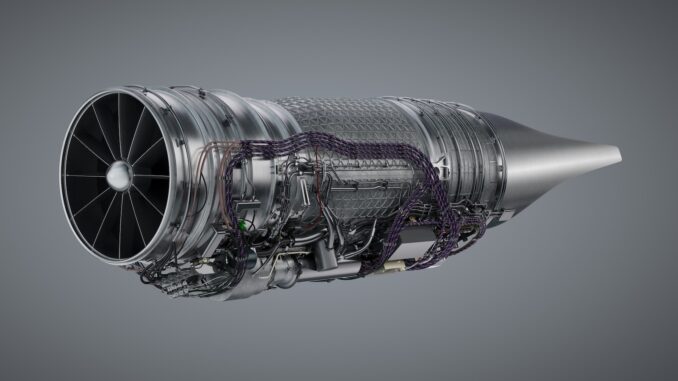
More thrust in combat, lower fuel consumption in cruise and additional cooling capacity for increasingly powerful onboard electronics: requirements that are difficult to reconcile in conventional fighter engines. Adaptive engines could help solve this conflict. The U.S. Air Force and engine manufacturers including GE Aerospace and Pratt & Whitney are developing propulsion systems designed to combine these capabilities.
For a commercial aircraft, the basic requirement is comparatively straightforward: the engine should operate as efficiently as possible over long distances. Fighter aircraft face a much broader range of demands. Range and fuel efficiency are important during cruise, but depending on the mission and situation, high thrust, rapid acceleration and high speed may become critical within seconds.
The proposed solution is the adaptive engine: a propulsion system capable of changing its internal airflow and adjusting its operating characteristics more closely to the respective flight condition.
For almost two decades, the U.S. Air Force and its industry partners have been advancing corresponding development programs. GE Aerospace’s XA102 and Pratt & Whitney’s XA103 now represent the next generation of adaptive fighter engines.
Three Airflows Instead of Two
In a conventional turbofan, the air drawn in by the fan is divided into two main flow paths. One portion enters the engine core, where it is further compressed and ultimately used in the combustion process. A second portion bypasses the core.
Both GE Aerospace and Pratt & Whitney use a three-stream architecture for their adaptive engine concepts. In addition to the core flow and the conventional bypass flow, a third airflow is available whose use can be adjusted depending on the operating condition.
During efficiency-oriented operation, the airflow can be configured to prioritize lower fuel consumption and greater range. When high performance is required, the engine can shift toward an operating condition optimized more strongly for thrust. For its earlier XA100 demonstrator, GE therefore referred to a High-Efficiency Mode and a High-Thrust Mode.
The fan, compressors, engine core and turbines remain part of one integrated propulsion system. Adaptation to different flight conditions is achieved through variable components and by changing how the airflow is routed and distributed within the engine.
The Third Stream Also Supports Cooling
The additional airflow serves another important purpose: thermal management.
Modern fighter aircraft require increasingly powerful radar, sensor, computing and electronic-warfare systems. As their performance increases, so does the amount of heat that must be removed from the aircraft.
The third stream provides comparatively cool air that can be used as part of the aircraft’s heat-management system. The engine is therefore becoming increasingly important not only as a source of thrust, but also as part of the aircraft’s overall power and thermal-management architecture.
For the XA100, GE cited significantly increased thermal-management capacity compared with previous fighter engines, along with approximately 25 percent better fuel efficiency and more than 10 percent additional thrust.
Almost Two Decades of Development
The current generation of adaptive three-stream engines is the result of several successive technology programs.
The development path began in 2007 with the Adaptive Versatile Engine Technology program, or ADVENT. Its initial focus was on establishing the technological foundation for an engine that would no longer be optimized around a single operating point, but could adapt more effectively to different mission requirements.
The Adaptive Engine Technology Development program, AETD, followed in 2012. Technologies previously investigated under ADVENT were developed further and key elements were advanced to higher technology-readiness levels. These included adaptive fans and airflow systems as well as new materials and approaches to thermal management.
The decisive step from technology development toward a complete engine came in 2016 with the Adaptive Engine Transition Program, or AETP.
GE and Pratt & Whitney each received contracts to develop, manufacture and test complete adaptive engines in flight-relevant configurations. These efforts produced GE’s XA100 and Pratt & Whitney’s XA101.
XA100 and XA101: From Concept to Complete Engine
GE developed the XA100, while Pratt & Whitney pursued the XA101. Both concepts were intended to demonstrate the advantages of an adaptive three-stream architecture in a complete fighter-class engine.
GE completed the design of the XA100 in 2019 and began testing the full engine with two prototypes from late 2020. The test programs generated extensive data on the aerodynamic, thermal and mechanical behavior of the new architecture.
Additional testing was still being conducted in 2024, with results explicitly intended to support development of the next generation of adaptive engines.
Pratt & Whitney developed the XA101 in parallel. This engine was likewise based on adaptive technologies previously matured under the AETD program. However, Pratt & Whitney has publicly released considerably less technical data and fewer test results for the XA101 than GE has for the XA100.
For a time, both engines were evaluated as potential future propulsion systems for the F-35. The Pentagon ultimately decided against replacing the aircraft’s engine and instead opted for an upgrade of the existing Pratt & Whitney F135.
NGAP: Two New Engines for the Next Generation of Fighters
For future fighter aircraft, the U.S. Air Force launched a parallel development effort under the Next Generation Adaptive Propulsion program, or NGAP.
The program is intended to develop adaptive engines for future combat aircraft and advance them through the full-scale demonstrator stage.
Once again, both manufacturers are developing competing propulsion systems: GE Aerospace is working on the XA102, while Pratt & Whitney is developing the XA103.
Both projects have now passed major development reviews.
GE completed the XA102 Detailed Design Review in February 2025. In May 2026, the program passed its Assembly Readiness Review. The review covered not only the engine design but also manufacturing processes and the supply chain.
The program is therefore moving from digital design toward assembly and testing of a complete demonstrator.
Pratt & Whitney has reached a broadly similar stage with the XA103. Its Detailed Design Review was also completed in 2025, followed by a fully digital Assembly Readiness Review in May 2026.
Components are now being procured and manufactured for an XA103 Prototype Ground Demonstrator. According to the company, ground testing is planned for the “late 2020s.”
Both manufacturers continue to disclose relatively little about specific performance figures. Publicly known development objectives primarily include greater fuel efficiency and range, high thrust capability and additional electrical and thermal capacity for future mission systems.
XA102 and XA103 Enter the Hardware Phase
The NGAP competition has therefore reached a clear transition point: the XA102 and XA103 are moving beyond the pure design phase and becoming physical hardware.