
Translation note: This article was translated with the assistance of AI.
Boeing’s 777-9 test fleet has logged more than 5,100 flight hours following a recent crosswind test campaign in Iceland. Certification of the long-haul aircraft remains underway, with the first delivery scheduled for 2027—approximately seven years behind the original plan.
A Boeing 777-9 arrived at Keflavík International Airport in late October for the type’s first visit to Iceland. Boeing used the deployment to assess the widebody’s flight characteristics in crosswinds. Iceland is the tenth country included in the 777-9 flight test program.
Crosswind tests assess how an aircraft behaves during approach, touchdown and rollout in varying wind conditions. They help establish its handling characteristics and operating limitations under defined conditions. Boeing released neither specific wind speeds nor results from the latest campaign.
The campaign forms part of a certification program that has run considerably longer than originally expected. Boeing says the 777-9 test fleet has completed more than 1,800 flights, totaling over 5,100 flight hours.
New Composite Wing with Folding Wingtips
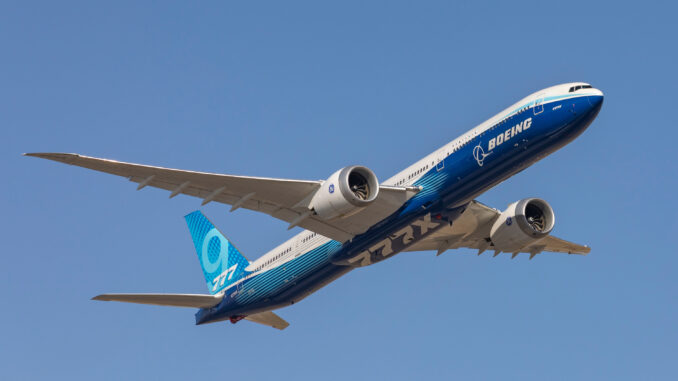
The 777-9 is the first member of Boeing’s new 777X family, developed from the existing 777. Its 76.7-meter fuselage makes it one of the world’s longest passenger aircraft. The principal design changes are in the wings and engines.
While earlier 777 variants have different wing construction, the 777-9’s wings consist primarily of carbon fiber reinforced polymer (CFRP). Greater span and optimized aerodynamic geometry are intended to reduce induced drag and improve efficiency, particularly on long-haul flights.
Folding wingtips allow the wingspan to change between flight and ground operations. The span measures 71.8 meters in flight; folding the outer sections upward on the ground reduces it to 64.8 meters.
The reduced span allows the 777-9 to use existing airport infrastructure designed for ICAO Code E aircraft. With the wingtips extended, its span would put it in the larger Code F category.
The wingtips must be fully extended and locked before takeoff. Their folding mechanism is monitored and integrated into the aircraft’s systems, allowing the design to combine the aerodynamic benefits of a larger wing with the operating requirements of existing airports.
GE9X: A New Engine Generation for the 777X
Two GE9X turbofans power the 777-9. GE Aerospace developed them specifically for the 777X family, and they rank among the largest and most powerful commercial aircraft engines ever developed.
Each fan measures approximately 3.40 meters in diameter and has 16 composite blades. Relative to the GE90, which powers aircraft including the Boeing 777-300ER, the GE9X has a larger fan, a higher bypass ratio and an advanced high-pressure compressor.
Ceramic matrix composites (CMCs) are used in engine components exposed to particularly high temperatures. These materials support higher operating temperatures at relatively low weight, helping improve thermal efficiency.
According to GE Aerospace, the GE9X offers up to 10 percent lower specific fuel consumption than the GE90-115B. The US Federal Aviation Administration (FAA) granted the engine its type certification in September 2020.
Engine certification does not, however, certify the complete aircraft. Boeing must separately demonstrate the interaction of the engines, aircraft systems and airframe during the 777-9 type certification process.
Approximately Seven Years Behind the Original Schedule
When Boeing officially launched the 777X family in 2013, it targeted first deliveries in 2020. The 777-9 made its first flight on January 25, 2020.
The entry-into-service date has since slipped several times. Technical difficulties in development and testing, additional certification requirements, and problems with the engines and aircraft structure have all contributed to the delays.
An unresolved GE9X durability issue is among the remaining technical challenges. Boeing disclosed the issue after inspections identified it in 2025. GE Aerospace traced the problem to an internal engine component called the mid-seal, which failed to meet durability expectations in testing. GE redesigned the seal and began supplying Boeing with engines incorporating the revision in the third quarter of 2026. At the time of the latest reported updates, FAA approval of the modification was still pending.
The delays have carried substantial financial costs. Boeing recorded an additional pretax charge of $4.9 billion in the third quarter of 2025 alone, tied to the revised 777X delivery schedule.
Boeing reaffirmed in October 2026 that it expected the first delivery in 2027. That schedule would place the 777-9’s commercial debut approximately seven years later than originally planned.
Flight Testing and FAA Certification
Flight testing continued to advance during 2026. Over the summer, Boeing reported that it had completed several test phases and received FAA authorization for further certification activities.
Boeing said approximately 50 percent of the planned certification testing was complete as of July 2026. The fleet had then accumulated around 1,700 flights and more than 4,800 flight hours. Structural fatigue testing had also passed the equivalent of one full aircraft service life.
Alongside the recent Iceland crosswind campaign, Boeing carried out extensive icing tests during the year. These covered natural icing conditions and simulated ice accretions on aerodynamically significant components.
The remaining certification work includes demonstrating compliance with extended-range twin-engine operational performance standards, commonly known as ETOPS. Boeing CEO Kelly Ortberg said in September 2026 that authorization for the associated flight tests still depended on resolving the GE9X durability issue. Some testing could therefore continue into 2027.
Boeing’s November announcement on the Iceland campaign gave no updated figure for the percentage of certification testing completed. The total of more than 5,100 flight hours covers the overall flight test program; it does not represent hours flown specifically for FAA certification.
First Deliveries Still Planned for 2027
Boeing intends the 777-9 to replace the 777-300ER on numerous long-haul routes. Lufthansa, Emirates, Qatar Airways and Singapore Airlines are among its customers.
The program has particular significance for Lufthansa. The first 777-9 destined for the German airline flew for the first time in May 2026. It has a complete passenger cabin, unlike the dedicated flight test aircraft, and is being used for further systems and cabin testing.
The Iceland crosswind campaign marks another step in testing the 777-9, whose design pairs a new composite wing and folding wingtips with engines developed specifically for the 777X family. First delivery in 2027 remains dependent on successful completion of the outstanding certification activities.