
Translation note: This article was translated with the assistance of AI.
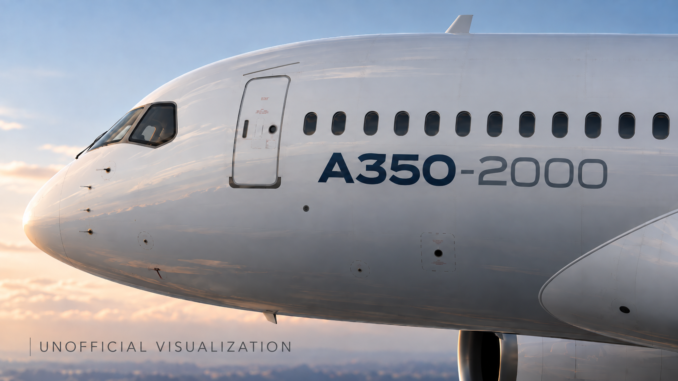
Airbus is considering a further expansion of its A350 family. The proposed aircraft, widely referred to as the A350-2000, could extend the manufacturer’s presence in the high-capacity long-haul segment. According to Lars Wagner, CEO of Airbus Commercial Aircraft, airlines have already expressed interest in a larger variant. Key questions remain unresolved, however, including the aircraft’s technical configuration, engine selection, and the timing of a potential program launch. Here is what is currently known about the possible Airbus A350-2000 — and what remains uncertain.
Airbus Sees Demand for a Larger A350
The A350 family could be getting another member. At a press event in Toulouse on October 14, Lars Wagner discussed the possibility of developing a stretched version of the long-haul aircraft. Talks with major airlines had indicated interest in a larger model, as Reuters and other news outlets reported.
The potential variant has been referred to within the industry as the A350-2000 for some time. Airbus has not publicly launched a formal development program, however. For now, the manufacturer is evaluating a possible extension of the existing A350 family. According to Wagner, decisions on larger versions of both the A350 and A220 could come at the beginning of a new five-year planning cycle. He did not specify a date.
How Much Larger Could the A350-2000 Be?
With the A350-1000, Airbus already offers a long-haul aircraft accommodating 375 to 400 passengers. Its fuselage measures 73.78 meters (242.1 feet) in length, with a wingspan of 64.75 meters (212.4 feet). Maximum takeoff weight reaches up to 324 metric tons.
Stretching the fuselage would create additional cabin space and allow Airbus to increase passenger capacity beyond that of the A350-1000. Such an aircraft could be particularly attractive to airlines serving high-demand long-haul routes, where carrying more passengers on each flight could offer operational advantages.
A Competitor to the Boeing 777-9?
The passenger capacity Airbus might target remains unclear. Citing industry sources, Reuters has reported that a design accommodating approximately 400 passengers is under consideration, without specifying a particular cabin layout. The existing A350-1000 already offers up to 400 seats in a typical three-class configuration.
A potential A350-2000 would compete with the Boeing 777-9, which measures 76.7 meters (251.9 feet) in length and, according to Boeing, accommodates between 375 and 450 passengers in a two-class configuration.
Direct capacity comparisons remain difficult as long as Airbus has not disclosed the proposed aircraft’s cabin configuration.
What Technical Changes Would Be Required?
At first glance, stretching an aircraft fuselage may appear relatively straightforward: Additional fuselage sections provide room for more rows of seats. The engineering implications, however, extend considerably further.
A longer fuselage affects weight distribution, bending moments, and structural loads. The aircraft’s structure must be designed to accommodate these changes, particularly at high takeoff weights and under the loads encountered during flight and ground operations.
The landing gear presents another challenge. With the rest of the aircraft geometry unchanged, a longer fuselage can reduce tail clearance during takeoff rotation. The resulting risk of a tailstrike, in which the rear fuselage contacts the runway, must therefore be considered early in the design process. Whether Airbus would need to modify the landing gear geometry cannot be determined without knowing the proposed aircraft’s actual dimensions.
Changes to the wing and its high-lift systems may also be necessary. Airbus already uses different structural and aerodynamic solutions within the same aircraft family, and a potential A350-2000 would likely require similar adaptations. Compared with the smaller A350-900, for example, the existing A350-1000 features a modified wing trailing edge and six-wheel main landing gear assemblies rather than four-wheel units.
Determining which existing components could be retained would be one of the key engineering decisions in developing an A350-2000.
The Engine Question Remains Open
Propulsion is another major consideration. The A350-1000 is powered by the Rolls-Royce Trent XWB-97, which delivers a maximum takeoff thrust of approximately 97,000 pounds-force (431 kilonewtons).
The Trent XWB-97 was specifically developed for the Airbus A350-1000. Compared with the lower-thrust Trent XWB-84, it features a larger engine core, operates at higher temperatures, and has a higher fan rotational speed. Both engine variants use a fan measuring 118 inches in diameter.
A larger aircraft with a higher maximum takeoff weight could require additional thrust. Whether the existing Trent XWB-97 has sufficient performance margins or whether an upgraded version would be needed depends on the final aircraft configuration. The intended range and aerodynamic characteristics would also influence that decision.
Wagner left unanswered whether Rolls-Royce would remain the exclusive engine supplier for a potential A350-2000. Citing industry sources, Reuters reported that Airbus had also considered an engine from GE Aerospace. The U.S. manufacturer’s interest has reportedly been limited so far, and no corresponding development agreement has been announced.
Larger Aircraft, Higher Production Rates
Regardless of the discussions surrounding a possible A350-2000, Airbus is already working toward a further increase in A350 production capacity. The manufacturer aims to reach a production rate of 12 A350 aircraft per month by 2028, a target it has previously announced.
According to Wagner, expanding output beyond that level would require an additional final assembly line and the associated industrial capacity.
The two initiatives are strategically connected. A larger A350 could attract additional customers and expand the aircraft portfolio. At the same time, developing another variant would require further engineering and manufacturing resources. Ultimately, the business case will depend on whether enough airlines can consistently fill the additional seats over the aircraft’s operational lifetime.