
Translation note: This article was translated with the assistance of AI.
After years of financial losses and thin margins, Rolls-Royce has returned to strong profitability. Its Civil Aerospace division alone now generates billions of pounds in operating profit. Yet the UK government is planning substantial support for Rolls-Royce. Under a ten-year research program, the government and Rolls-Royce plan to jointly invest £2.5 billion in new gas turbine technologies. Why is the government investing in a company that is already highly profitable?
The £2.5 billion does not represent an approved government grant. It is the planned total value of a jointly funded research and technology program. How the costs will be divided between the government and Rolls-Royce remains under negotiation.
Returning to the Narrowbody Engine Market
The program is intended to pave the way for Rolls-Royce’s return to the narrowbody aircraft engine market, a segment in which the company has not competed with a new engine program since selling its stake in International Aero Engines to Pratt & Whitney in 2012. Today, the market is dominated by CFM International, a joint venture between GE Aerospace and Safran Aircraft Engines, and Pratt & Whitney. From a strategic perspective, Rolls-Royce’s ambitions are understandable.
However, Rolls-Royce is not necessarily dependent on government investment or subsidies. The company’s Civil Aerospace division has significantly improved its profitability since 2022. After generating an underlying operating profit of £143 million in 2022, the division reported £2.13 billion in 2025. In the first half of 2026, its underlying operating margin reached 25.3%.
UK Industry Minister Blair McDougall has now explained to Reuters why the government intends to make such a substantial investment.
“We Want Those Engines to Be Designed, Developed and Serviced Eventually Here in the UK”
“We want those engines to be designed, developed and serviced eventually here in the UK,” McDougall told Reuters. “There are countries all over the world trying to eat our lunch when it comes to aerospace jobs and the aerospace supply chain.”
The UK government therefore sees Rolls-Royce’s planned return to the narrowbody market not merely as a commercial venture, but primarily as an opportunity to strengthen the country’s industrial base.
Rolls-Royce CEO Tufan Erginbilgic expressed a similar view: “This is a landmark moment for the UK’s aerospace industry. This is a once-in-a-generation opportunity to lay the foundations for decades of sustainable economic growth across the UK, creating high-value jobs and transforming the country’s advanced manufacturing supply chain. […]
Working together, we can also sustain the nation’s capability to power military aircraft and secure its position as one of only two countries that can design, develop, make and service the jet engines that power the world’s commercial airliners.”
The central issue is long-term economic value creation. According to the government, the initial phase of the program is expected to safeguard around 3,300 existing jobs by the end of 2029. If the new engine technologies are subsequently selected for future aircraft programs, McDougall believes they could support tens of thousands of jobs at Rolls-Royce and throughout its supply chain over the longer term.
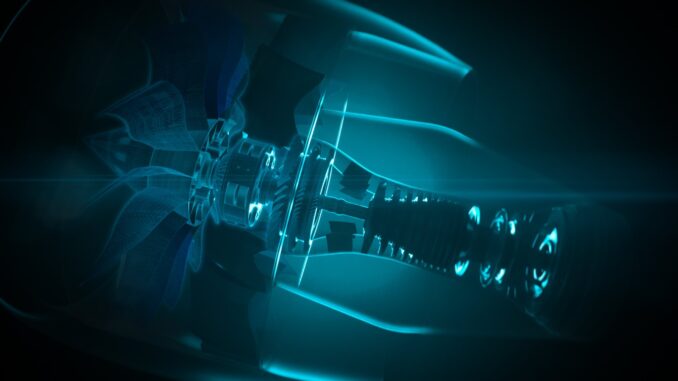
The UltraFan development program provides a technological foundation for these ambitions. Rolls-Royce is already developing the UltraFan 30, a demonstrator targeting lower thrust classes. The design combines a reduction gearbox with new fan and engine core technologies. Initial ground testing of the UltraFan 30 is scheduled for 2028.
Funding Arrangements Remain Undecided
How much funding the UK government will ultimately provide has yet to be determined. “We are still in discussions,” McDougall said. “It’s a commercial conversation from Rolls-Royce’s end and a value-for-money conversation from our end.”
McDougall described the joint initiative as “re-industrialisation in action.” He said the government was backing jobs that not only provide productive, highly skilled employment but also give communities surrounding industrial facilities a sense of pride and purpose.
The agreement currently establishes only the framework for potential government support. According to the government, no new grants have yet been awarded. Any future funding will be subject to legal reviews, value-for-money assessments, affordability checks and the required government approvals.
Images: Rolls-Royce