
Translation note: This article was translated with the assistance of AI.
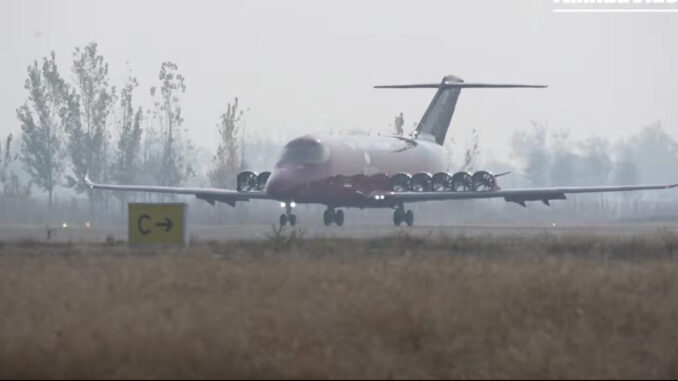
Chinese aircraft manufacturer COMAC has reached another milestone in the development of battery-electric regional aircraft. On November 14, 2026, the CE-25A, designed to accommodate 19 passengers, completed its first crewed test flight. The demonstrator features ten electrically driven ducted fans distributed across its wings. Development partners include battery manufacturer CATL and Shanghai Jiao Tong University. While flight testing progresses, key questions remain regarding battery technology, actual range, and the aircraft’s potential economic viability.
The CE-25A departed from Binzhou Dagao Airport in eastern China’s Shandong Province on November 14 for its first crewed test flight. The crew consisted of two pilots and one flight test engineer. According to COMAC (Commercial Aircraft Corporation of China), the flight proceeded as planned, with all monitored parameters remaining within the expected limits.
The entire test sequence lasted 57 minutes and 46 seconds, including 16 minutes and 38 seconds of actual flight time. The aircraft covered a distance of 60.4 kilometers (37.5 miles). The milestone followed several months of flight testing. The CE-25A first flew autonomously without a crew on February 2, 2026. According to COMAC, the aircraft completed a total of 19 uncrewed test flights before carrying people on board for the first time.
Chinese news agency Xinhua reported on the crewed test flight on November 14, citing information provided by COMAC.
Electric Regional Aircraft Designed for 19 Passengers
COMAC is developing the battery-electric CE-25A for short regional routes, with commercial flights between relatively nearby cities envisioned as a potential application.
According to the manufacturer, the aircraft is designed to carry up to 19 passengers. With a maximum takeoff weight of ten metric tons, COMAC specifies a cruise speed of 300 km/h (162 knots), a cruise altitude of 2,400 meters (7,874 feet), and a range of 400 kilometers (216 nautical miles).
However, the published performance figures provide only a limited basis for assessing the aircraft’s operational capabilities. It remains unclear under which conditions the CE-25A is expected to achieve its stated range. Information on the assumed payload, required energy reserves, and potential limitations resulting from ambient temperatures has not been disclosed. Consequently, the successful test flight covering approximately 60 kilometers does not establish whether the advertised range can also be achieved with a full passenger load under normal operating conditions.
COMAC describes the CE-25A as its first electric commercial aircraft. The technology demonstrator is currently undergoing flight testing, and it remains uncertain whether the concept will eventually lead to a production aircraft program.
The Chinese state-owned manufacturer is best known for its C909 regional jet and C919 narrowbody airliner. With the electric demonstrator, COMAC is expanding its development activities into alternative propulsion technologies.
Ten Ducted Fans Instead of Conventional Engines
The most distinctive technical feature of the CE-25A is its propulsion architecture. Instead of the two turboprop or jet engines typically used in conventional aircraft of this category, the CE-25A employs ten electrically driven ducted fans.
The propulsion units are arranged in two groups of five above the wings. These spatially distributed units collectively generate the required thrust. The concept is known as Distributed Electric Propulsion (DEP).
A ducted fan consists of a rotating bladed rotor enclosed by an annular duct. The surrounding duct influences airflow through the fan and, with an appropriate aerodynamic design, can improve its efficiency. However, potential disadvantages include additional weight, aerodynamic drag, and the challenges associated with integrating the units into the aircraft structure.
In the CE-25A, the propulsion units are located close to the wings, potentially creating additional aerodynamic interactions between the airflow accelerated by the fans and the airflow over the wing surfaces.
Such concepts have been investigated in various research programs for years. One example is NASA’s experimental X-57 Maxwell aircraft, whose planned final configuration featured 14 electric propeller propulsion units. Twelve smaller propellers along the wing leading edges were intended to accelerate airflow at low airspeeds and increase lift, while two larger propulsion units were designed to provide thrust during cruise flight.
However, the X-57 never completed its first flight. NASA concluded the operational phase of the program in 2023, with final project closeout following in 2024. Nevertheless, wind tunnel testing, simulations, and ground tests generated valuable findings, particularly concerning the integration of electric propulsion systems and their power supplies.
For the CE-25A, it has not yet been documented whether or to what extent COMAC achieves comparable aerodynamic benefits. No published performance data are available to demonstrate increased lift or shorter takeoff and landing distances.
Distributed Propulsion Creates New Requirements for Aircraft Systems
In addition to potential aerodynamic benefits, distributed electric propulsion provides greater flexibility in propulsion system design.
Electric motors can generally be controlled independently, allowing the rotational speed and thrust of individual units to be adjusted for different operating conditions. In aircraft designed for this purpose, differential thrust distribution can also support flight control. Whether COMAC intends to implement such functions on the CE-25A remains unknown.
At the same time, the large number of propulsion units increases the demands placed on the overall system. Electric motors, power electronics, electrical power distribution, wiring, and cooling systems must all be coordinated.
System behavior under failure conditions is particularly important. The failure of an individual propulsion unit changes thrust distribution along the wing. In a distributed architecture, common-mode failures in the electrical power supply may also affect multiple propulsion units simultaneously.
Certification assessments must therefore address not only individual components but also the consequences of different combinations of failures. Their effects on flight stability and remaining propulsion capability must be evaluated.
NASA investigated similar questions during the X-57 program. In such configurations, the consequences of a propulsion unit failure depend not only on the remaining total thrust. The location of the failed unit and possible changes in airflow over the wings may also influence aircraft behavior.
Battery Manufacturer CATL Involved in Development
One of the development partners in the CE-25A program is Chinese battery manufacturer Contemporary Amperex Technology Co. Limited (CATL).
COMAC is collaborating with CATL, Shanghai Jiao Tong University, and other Chinese partners. However, the specific development responsibilities and supply arrangements of the participating organizations have not yet been fully disclosed.
The performance of a battery-electric aircraft depends significantly on the gravimetric energy density of its batteries. This describes the amount of electrical energy a battery system can store relative to its mass.
Unlike a conventionally powered aircraft, a battery-electric aircraft experiences virtually no reduction in mass as energy is consumed during flight. The batteries remain on board throughout the entire flight, even after some of their stored energy has been used.
Takeoff and climb also require high levels of electrical power. The batteries must therefore provide not only sufficient stored energy but also the required power output without thermal or electrical overload.
Additional requirements include cooling, individual cell monitoring, and protection against thermal runaway. This process involves uncontrolled heat generation within a battery cell, potentially causing a rapid temperature increase. Under unfavorable conditions, the affected cell may damage adjacent cells.
For the CE-25A, the capacity, energy density, cell chemistry, and total mass of the installed battery system have not yet been sufficiently documented in publicly available information. Details concerning maximum charging power and expected battery service life are also unavailable.
As a result, it is currently impossible to assess how much payload the aircraft could carry under realistic operating conditions or what operational limitations its energy storage system might impose.
Chinese Aviation Authority Has Accepted the Type Certification Application
While flight testing continues, COMAC is preparing for the CE-25A’s type certification.
According to the manufacturer, the Civil Aviation Administration of China (CAAC) has accepted the application for type certification.
The CE-25A designation refers in part to China’s CCAR-25 airworthiness regulations for transport category airplanes. These regulations form the intended regulatory framework for type certification. However, acceptance of the application does not mean that the aircraft has already demonstrated compliance with the applicable requirements.
A battery-electric aircraft featuring distributed propulsion presents specific certification challenges. These include the safe operation of high-voltage electrical systems, battery failure behavior, propulsion system reliability, and the ability to manage different failure scenarios.
Other aviation authorities are also addressing the particular characteristics of electric propulsion systems. The European Union Aviation Safety Agency (EASA), for example, has established specific requirements for electric and hybrid propulsion systems through its Special Condition SC E-19. However, these European requirements do not automatically apply to the Chinese certification process for the CE-25A.
Additional or project-specific requirements imposed by the CAAC have not yet been disclosed in detail. No target date has been announced for type certification or the start of commercial operations.
Electric Regional Aircraft: China Is Not the First to Develop One
The CE-25A’s successful first crewed flight represents an important development milestone for COMAC, but it is not a world first in electric passenger aviation.
The US-developed Eviation Alice completed its maiden flight in September 2022. The all-electric aircraft was designed to carry nine passengers.
An earlier certification milestone was achieved by Slovenian manufacturer Pipistrel. In June 2020, the European Union Aviation Safety Agency granted type certification to the two-seat Velis Electro training aircraft, making it the world’s first fully electric aircraft to receive such approval.
With the CE-25A, COMAC is pursuing a different technological approach. While the Alice uses a relatively conventional configuration with two electric propeller propulsion units, COMAC integrates ten electrically driven ducted fans into the wing architecture.
With a planned passenger capacity of 19, the CE-25A also occupies a higher capacity segment than smaller electric aircraft designed for flight training or transporting only a few passengers.
Whether the concept can ultimately support an economically viable regional airliner remains uncertain.
From Technology Demonstrator to Commercial Aircraft: A Long Road Ahead
Following its uncrewed flight trials, COMAC has now successfully demonstrated the CE-25A in flight with a crew on board. This marks another step toward a possible commercial application.
However, major uncertainties remain, particularly regarding battery performance and the resulting operational capabilities. A nominal range of 400 kilometers provides only limited insight into which routes could actually be served with the required payload, under varying weather conditions, and while maintaining the necessary energy reserves.
Important information is also missing for an assessment of economic viability. In addition to acquisition and maintenance costs, key factors include battery service life, charging times, and the charging infrastructure required at airports.
Electric propulsion systems have the potential to reduce the mechanical complexity of individual propulsion units and eliminate local CO₂ emissions from fuel combustion during flight. However, without detailed technical and economic data, it is not possible to determine whether an aircraft with ten propulsion units could also achieve lower maintenance and operating costs.
The CE-25A combines electric propulsion technology with an unconventional approach to aerodynamic integration. By completing its first crewed flight, COMAC has demonstrated another step forward in the aircraft’s development. What remains to be proven is whether the concept can evolve into a certified, operationally safe, and economically viable regional airliner.