
Translation note: This article was translated with the assistance of AI.
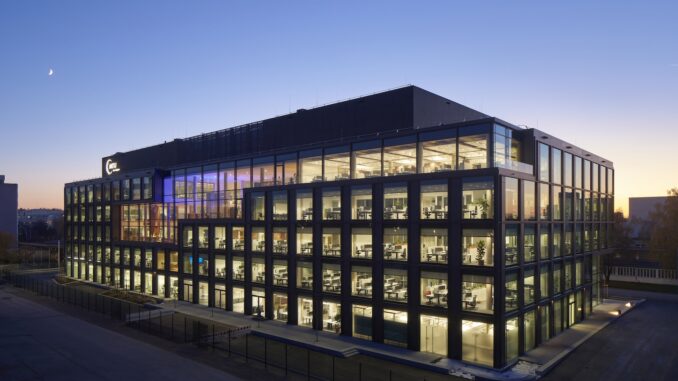
MTU Aero Engines has opened a development center at its Munich headquarters to develop propulsion technologies for civil and military aircraft. The engine manufacturer invested more than €100 million in the facility, which will accommodate up to 1,000 employees. Their work will span more efficient gas turbine engines, hydrogen fuel cell propulsion, advanced materials, and new manufacturing and repair processes.
The center covers more than 20,000 square meters and brings several engineering and technology disciplines together at MTU’s Munich headquarters. MTU expects the shared location to improve collaboration on future aircraft propulsion systems.
German Chancellor Friedrich Merz and Bavarian Minister-President Markus Söder attended the official inauguration on November 16, 2026. They joined members of MTU’s management in symbolically commissioning the building.
Developing More Efficient Engines and New Propulsion Concepts
Research and development will concentrate on improving the efficiency of future aircraft engines and reducing their emissions. The work encompasses further development of conventional gas turbines and research into alternative propulsion systems.
The Flying Fuel Cell (FFC) is one of MTU’s long-term development projects. It uses hydrogen fuel cells to generate electricity for electric aircraft propulsion. MTU’s goal is a propulsion system whose only reaction product during flight operations is water.
Other areas of development include advanced materials, lightweight structures, and new manufacturing and repair processes. These technologies have applications in both civil engine programs and military aviation.
New Technologies for the Next Generation of Aircraft Engines
MTU’s work on the Pratt & Whitney GTF Advantage illustrates the continued development of existing engine technologies. According to the manufacturer, the upgraded geared turbofan delivers four to eight percent more takeoff thrust than its predecessor. The first Airbus A321XLR powered by GTF Advantage engines was delivered to United Airlines in September 2026.
At the new center, MTU plans to refine gas turbine technologies and investigate alternative propulsion concepts that require longer development timelines. Bringing engineering teams into close proximity is expected to help them collaborate across disciplines on this work.
MTU Continues to Invest in Its Munich Headquarters
The development center is part of an ongoing expansion at MTU’s Munich headquarters. The company commissioned a highly automated turbine disk manufacturing facility in 2024, and an on-site geothermal system has supplied heat to the site since 2025.
MTU’s investment in development infrastructure comes amid a long-term rise in demand for commercial aircraft and their propulsion systems. The company aims to strengthen its position as a technology partner to international aircraft engine manufacturers by bringing its development activities together.
Image: MTU Aero Engines