
Translation note: This article was translated with the assistance of AI.
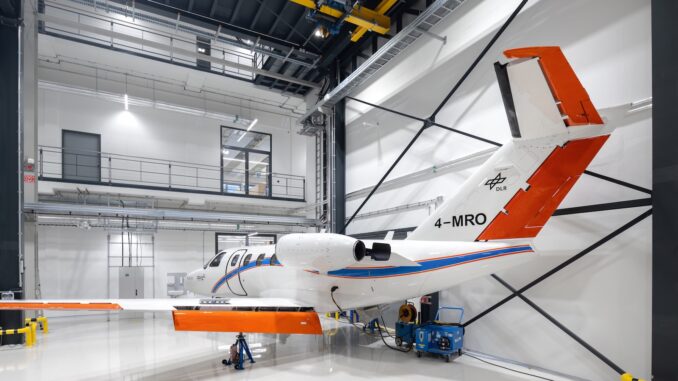
The German Aerospace Center (DLR) has opened a research laboratory in Hamburg to develop advanced aircraft maintenance methods. A modified Cessna Citation CJ will allow researchers to test inspection and repair techniques, robotic assistance systems, and data-driven maintenance concepts under realistic conditions. The business jet’s technical systems remain largely operational despite the extensive modifications needed to prepare it for research.
The MRO Living Lab officially opened on November 16, 2026, at the DLR Institute of Maintenance, Repair and Overhaul in Hamburg’s ZAL TechCenter. Researchers will use the facility to investigate aircraft maintenance, repair and overhaul (MRO) technologies under realistic conditions and support their adoption in the aviation industry.
Built in 1998, the retired Cessna Citation CJ gives researchers access to a full-scale aircraft for experiments that conventional laboratories often restrict to individual components. It also provides a setting for studying how new technologies and procedures fit into maintenance workflows.
Cessna Citation CJ as a Technical Test Platform
Extensive modifications were needed to prepare the Citation CJ for laboratory use. One wing and one horizontal stabilizer were removed so the aircraft would fit inside the designated hall. Changes to the control systems kept the flaps and ailerons operational.
The aircraft retains functioning technical systems and largely complete maintenance documentation. According to DLR, both were important criteria in selecting the research platform.
A dedicated measurement door on the right side of the fuselage provides access to sensor data even when the cabin is pressurized for tests. Researchers can therefore take measurements across different operating and test conditions.
Painted and Unpainted Fuselage Surfaces for Material Inspection
The fuselage has two different surface treatments: its left side is painted, while its right side remains unpainted.
Researchers can use this arrangement to study the effects of paint layers on inspection and diagnostic methods. Their work includes non-destructive testing (NDT), which detects damage or material changes without destroying the components being inspected.
Coatings can affect how certain measurement techniques are applied and how their results are interpreted. The Citation CJ allows researchers to examine different surface conditions in the same test environment, including with methods that require an unpainted surface.
Robotics, AI and Data-Driven Maintenance
DLR’s work extends from individual aircraft components to the digitalization of maintenance processes. Research covers data-driven maintenance planning as well as robotic assistance systems.
Data on an aircraft’s technical condition could improve predictions of maintenance needs and enable more precise planning. The goal is to use existing data to inform maintenance decisions.
DLR is also examining how maintenance personnel can work with artificial intelligence, robotic systems and visual assistance technologies. Researchers are studying how these tools can assist technicians and fit into existing maintenance workflows.
The Citation CJ’s compact design makes it particularly suitable for this work. Limited space and closely packed technical systems restrict access to components, creating additional challenges for automated inspection and repair.
Part of a Larger Research Infrastructure
The MRO Living Lab belongs to the Application Center MRO at the DLR Institute of Maintenance, Repair and Overhaul. Other facilities at the center include a project laboratory for robotic assistance systems, a Vision Lab for tracking and extended reality technologies, and a measurement laboratory.
These facilities support research into the digitalization and automation of aircraft maintenance, covering robotics, 3D measurement, augmented reality and mobile sensor technology.
DLR also applies a “Design for Operation” approach that accounts for operational and maintenance requirements when developing new aircraft technologies. The Living Lab will allow researchers to investigate these concepts in practice.
Alongside research and education, the facility is intended to support joint projects with industry partners. These activities will connect scientific development with potential future applications of new MRO technologies in aviation.
Images: DLR (Creative-Commons CC BY-NC-ND 3.0)