
Translation note: This article was translated with the assistance of AI.
Kawasaki Heavy Industries has successfully tested a small jet engine with a newly developed hydrogen combustor in Japan. Its Micromix technology is designed to significantly reduce nitrogen oxide emissions during hydrogen combustion. The test forms part of a Japanese research program on hydrogen-powered aircraft.
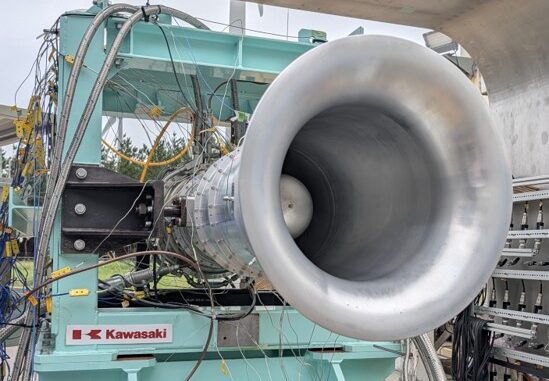
Testing took place at the Noshiro Rocket Testing Center, operated by the Japan Aerospace Exploration Agency (JAXA), using a small gas turbine engine fueled entirely by hydrogen.
According to Kawasaki, the engine demonstrated stable combustion and generated thrust across a range of operating conditions. Testing covered ignition, engine startup, steady-state operation under simulated cruise conditions, acceleration, deceleration, and shutdown.
Multiple Small Flames Instead of a Single Large Combustion Zone
The new combustor uses Kawasaki’s Micromix technology, originally developed for stationary gas turbines used in power generation.
Micromix combustion injects hydrogen through numerous small openings and mixes it with air to produce multiple small flames with short reaction times. This approach is intended to prevent localized areas of particularly high combustion temperatures.
Controlling these temperatures is particularly important when burning hydrogen. Although the fuel itself produces no carbon dioxide during combustion, high temperatures can cause nitrogen in the air to react with oxygen and form nitrogen oxides (NOx).
The new combustor is designed to limit this thermal NOx formation.
Further Development Through 2030
Kawasaki reports stable operating conditions and low nitrogen oxide emissions, with the potential to achieve particularly low NOx levels. The published announcement, however, provides neither specific measurements nor a quantified comparison with conventional aircraft engines.
The research program is funded by Japan’s New Energy and Industrial Technology Development Organization (NEDO) and aims to develop fundamental technologies for hydrogen-powered aircraft.
Scheduled to continue through 2030, the development phase also includes studies on integrating the aircraft, engine, hydrogen tanks, and associated systems. Kawasaki plans further ground testing of an integrated system.
The latest test demonstrates that the new combustor functions in a small jet engine. It does not yet represent a fully integrated hydrogen propulsion system certified for flight operations.