
Translation note: This article was translated with the assistance of AI.
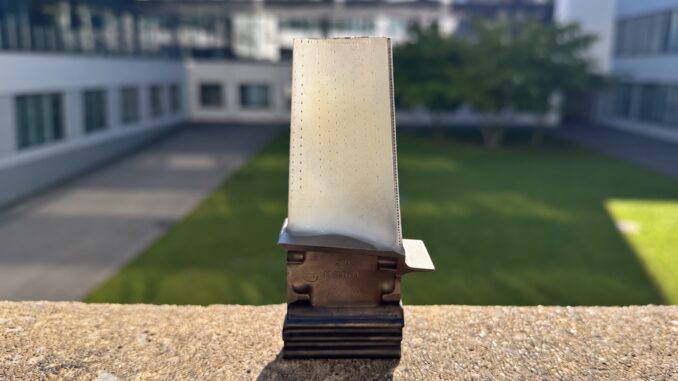
Turbine blades in modern aircraft engines face some of the highest stresses of any aircraft component. Extreme thermal and mechanical loads can make replacement necessary after just a few thousand flight cycles for first-stage blades, depending on the engine type and operating conditions. A consortium led by Ruhr University Bochum is investigating whether the damage can be reversed.
Through the “Second_Life” project, researchers and industry partners aim to develop a process to restore much of the mechanical performance that worn blades originally provided, potentially enabling their return to service.
Extreme Operating Conditions: Why Aircraft Engine Turbine Blades Deteriorate
Modern aircraft engine turbine blades operate at hot gas temperatures above 1,600 degrees Celsius while enduring high centrifugal forces and fluctuating thermal loads. Blades in the first turbine stage are particularly exposed.
Even heat-resistant alloys can develop microscopic voids, or creep cavities, under high temperatures and mechanical stress. These cavities form during creep: the slow, permanent deformation of a material under sustained mechanical stress. As they grow, they can weaken the material.
First-stage turbine blades are made from single-crystal nickel-based superalloys to limit these effects. Their atoms form a continuous crystal lattice throughout the component, eliminating grain boundaries. These interfaces between individual crystals can act as weak points at elevated temperatures.
Damage still accumulates in service. “During turbine operation, the blades are subjected to tensile stresses caused by rotational centrifugal forces at high temperatures, resulting in damage through creep-fatigue,” explains Professor Sebastian Weber. This microstructural damage limits blade service life.
“Second_Life” Research Project Aims to Regenerate Turbine Blades
Professor Sebastian Weber and Dr. Louis Becker of the Chair of Materials Technology at Ruhr University Bochum lead the team seeking to restore the components and extend their service life. Their work brings together academic and industry partners in the “Second_Life” collaborative research project.
Partners include the German Aerospace Center’s (DLR) Institute of Materials Research in Cologne, Lufthansa Technik, surface treatment specialist Aalberts Surface Technologies, and metalworking company Otto Fuchs of Meinerzhagen, Germany. Among its products, Otto Fuchs manufactures highly stressed forged components and nickel alloy parts for aerospace applications.
The project began in August 2026 and will run for three years, with funding through the German Federal Ministry for Economic Affairs and Energy’s LuFo Klima VII-1 aviation research program.
Hot Isostatic Pressing: How Creep Cavities in Turbine Blades Could Be Closed
“The microstructure and mechanical properties are to be restored using hot isostatic pressing, or HIP,” explains research group leader Louis Becker.
HIP subjects components to high temperatures and gas pressure simultaneously, with pressure acting uniformly from all directions. The treatment is intended to close creep cavities within the material while preserving the blades’ single-crystal structure.
Restoring the original microstructure and mechanical properties could enable the blades to return to service once their protective coatings have been reapplied.
HIP Has Been Established in the Aerospace Industry for Decades
The aerospace industry has used hot isostatic pressing for decades, including to close pores formed during turbine blade casting. Previous scientific studies have also examined the regeneration of damaged single-crystal nickel-based superalloys. “Second_Life” aims to develop these approaches further using damage conditions representative of service.
The challenge is to close creep cavities and restore the original mechanical properties as fully as possible while retaining the single-crystal structure.
In 2017, a Ruhr University Bochum research team that included materials scientist Professor Gunther Eggeler investigated hot isostatic pressing to regenerate a single-crystal nickel-based superalloy. The treatment closed creep cavities and restored key microstructural features without triggering recrystallization.
Those experiments, however, used a material specimen rather than a complete turbine blade.
For the new project, scientists at the German Aerospace Center will first produce controlled creep-fatigue damage at high temperatures representative of engine operation. Researchers at Ruhr University Bochum will then develop suitable HIP process parameters and analyze the resulting changes in the microstructure.
Mechanical tests on successfully treated specimens will subsequently establish whether the process can also restore the material’s mechanical performance.
“By extending the service life of turbine blades, we can reduce both the demand for newly manufactured components and the associated consumption of energy and raw materials,” says Sebastian Weber.