
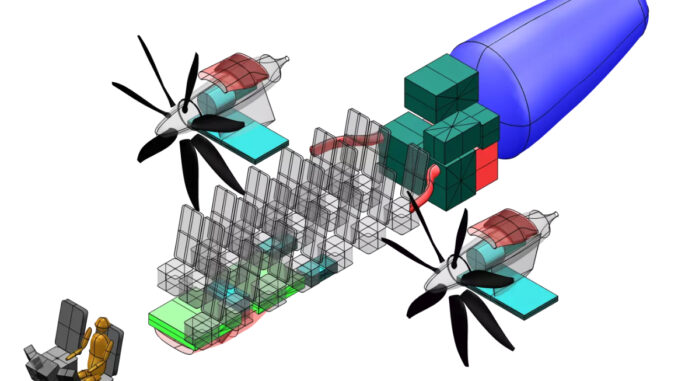
In the European research project NEWBORN, 18 partners from different disciplines are developing a propulsion system powered by hydrogen fuel cells. The project has now reached another milestone on the way toward a hydrogen-electric aircraft propulsion system in the megawatt range.
Led by Honeywell Aerospace, the main subsystems of a fuel-cell power source have been integrated into a functional overall system. According to Honeywell, the system is now capable of generating electrical energy from hydrogen and supplying it for use in an electric aircraft propulsion system. The work was carried out by Honeywell’s engineering team in Brno, Czech Republic, together with other project partners.
Fuel-cell power source for electric aircraft propulsion
For the tests, Honeywell developed a dedicated test rig capable of reproducing various aircraft functions and operating conditions. It is currently located at the ÚJV Řež research organization near Prague. In addition to the fuel cells themselves, the setup includes media supply systems, electrical components, control and safety equipment, as well as systems for heat dissipation.
The tests carried out so far have focused on the interaction between the individual subsystems. These included checks of leak tightness, operating parameters within the fluid circuits, control algorithms and protective functions. Further testing is now intended to expand the usable operating range and investigate the system’s stability and robustness.
NEWBORN develops megawatt-class propulsion system
NEWBORN stands for “NExt generation high poWer fuel cells for airBORNe applications” and is part of the Clean Aviation Joint Undertaking, a public-private research initiative of the European Union and the European aviation industry. Launched in 2023, the research project is developing a scalable hydrogen fuel-cell propulsion system for aviation. The objective is to build a complete ground demonstrator at Technology Readiness Level 4.
The concept is based on fuel-cell modules in the 1 MW class. Several of these modules are intended to operate in parallel, enabling propulsion systems with a power output of more than 3 MW. Clean Aviation states a target specific power of more than 1.2 kW/kg for the fuel-cell power source. NEWBORN initially targets the largest CS-23 aircraft class with 19 passenger seats.
Two propulsion systems are intended to provide a combined take-off power of around 2 MW. According to the project, a solution for CS-23 aircraft is expected to be available by 2030, followed by a solution for CS-25-category aircraft by 2035.
Next step: complete hydrogen-electric powertrain
Once the current tests have been completed, the hydrogen power source is to be transferred to Gorizia, Italy. There, it will be integrated with battery systems from Pipistrel and a megawatt-class electric propulsion system. The latter was jointly developed by the University of Nottingham, Honeywell Aerospace and Pipistrel.
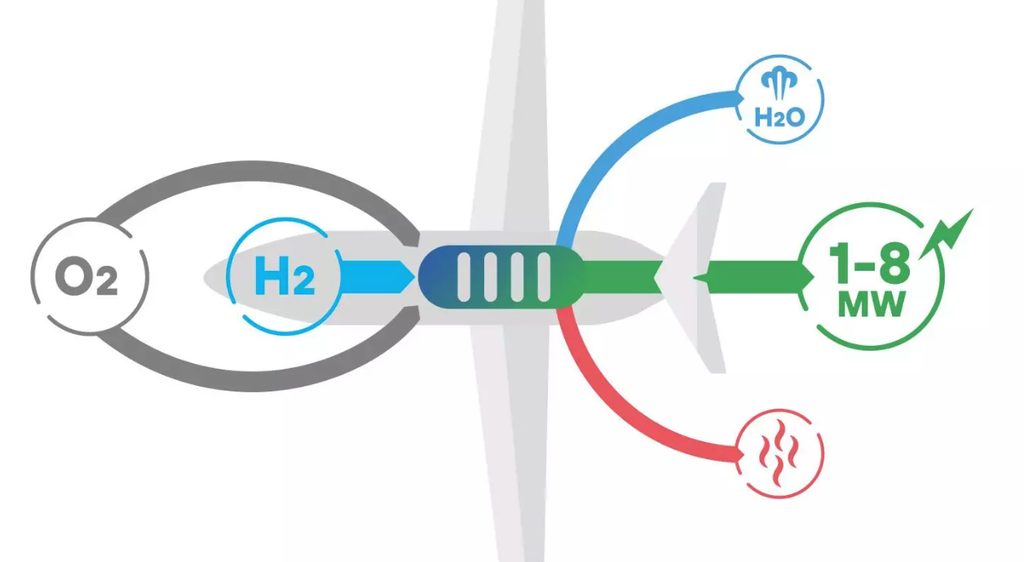
This will create a complete propulsion chain within NEWBORN: the fuel cells generate electrical energy from hydrogen, batteries complement the energy system, and an electric motor ultimately drives an aircraft propeller.
Hybrid-electric regional aircraft: interface with HERA
An important link exists with HERA (Hybrid-Electric Regional Architecture), another project funded through Clean Aviation. The project investigates how future hybrid-electric regional aircraft could be designed at an architectural level.
The project focuses on aircraft with approximately 50 to 100 seats. It examines different aircraft and propulsion architectures and their integration. These include fuel cells and batteries, electric propulsion systems and megawatt-class high-voltage distribution networks, as well as thermal management, new wing and fuselage concepts, and the integration of alternative energy carriers.
Images: Honeywell Aerospace