
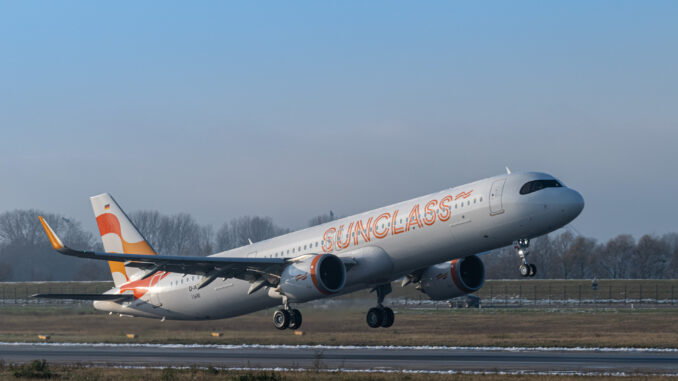
The A321neo is one of the most technically interesting developments within the A320 family. Its significance lies less in any single component than in the combination of new engines, aerodynamic refinements and a platform whose mission spectrum now stretches from conventional medium-haul services to long intercontinental routes.
From the A321ceo to the neo generation
Airbus retained the basic fuselage cross-section and large parts of the systems architecture, but introduced a new generation of engines with the LEAP-1A and PW1100G-JM. Sharklets, changes to the cabin and systems, and higher-weight variants followed. This evolutionary approach preserves fleet commonality and reduces training requirements, but it also makes integration demanding: larger engines and higher masses have to be accommodated within an existing airframe.
Range is about more than fuel volume
The additional range of the A321neo is not simply the result of carrying more fuel. Specific fuel consumption, aerodynamic drag, take-off mass and the payload that can still be carried over a given distance are equally important. The A321LR and, above all, the XLR show how Airbus has gradually moved the platform into a segment that was once largely reserved for widebody aircraft.
The A321neo is a system of engineering compromises
The greater range of today’s A321 variants does not stem from a single technological leap. Airbus combines an essentially unchanged fuselage with new engines, detailed aerodynamic improvements, higher certified weights and a systems architecture refined over decades. Economically, this is attractive because crews, maintenance and spare-parts logistics largely remain within the A320 family. Technically, however, it creates a demanding integration task: wing, landing gear, brakes and structure must absorb additional loads without turning the aircraft into something other than a single-aisle jet.
LEAP-1A and PW1100G: two routes to the same objective
A321neo customers can choose between the CFM LEAP-1A and the Pratt & Whitney PW1100G-JM. Both use large fans and high bypass ratios, but their low-pressure architectures differ fundamentally. Pratt & Whitney decouples the fan from the low-pressure turbine through a reduction gearbox; CFM uses a direct-drive architecture and relies, among other things, on advanced materials and a compact core. For airlines, the choice is not simply about fuel burn. Maintenance agreements, spare-parts support, existing fleets and the experience of the technical operation all matter.
Where the A321neo reaches its limits
The aircraft’s strength is also its limitation. A narrow fuselage makes it easy to use established A320 infrastructure, but it constrains aisle width, galley space and boarding speed. On long flights, water, catering and baggage also become more important. The A321neo therefore illustrates why range alone does not determine whether an aircraft is well suited to a mission. Cabin layout, turnaround time, cargo volume and reserve requirements are all part of the engineering equation.
What this means for the design
The A321’s range growth has only been possible because Airbus has adjusted many smaller variables within the same basic airframe: tank volume, certified masses, aerodynamics, engine fuel burn and cabin layout. On longer missions, turnaround time itself becomes a systems issue because a single-aisle aircraft still has only one aisle while carrying more catering, water and baggage.
Two engine concepts for the same airframe
One distinctive feature of the A321neo is the choice between two engine families. CFM International supplies the LEAP-1A; Pratt & Whitney supplies the geared-fan PW1100G-JM. Both pursue the same objective – lower specific fuel consumption and lower emissions than the previous generation – but achieve it through different engineering approaches. For airlines, engine selection therefore affects far more than fuel burn. It influences maintenance contracts, spare-parts supply, fleet harmonisation and the accumulated experience of the operator’s engineering organisation.
The larger fan diameters of the new engines also had to be integrated into an aircraft family whose basic geometry dates back to the 1980s. That is a defining characteristic of the A321neo: it is not a clean-sheet design, but a far-reaching evolution of an established platform.
Why the A321neo changed the market
The technical impact of the neo generation is most obvious in its mission profile. A single-aisle aircraft that is efficient on short- and medium-haul sectors can, in LR and XLR form, also operate routes that were once typically flown by smaller widebodies. This changes not only the aircraft’s range but also airline network planning. Carriers can open thinner long-haul routes without immediately committing to the seat capacity of a twin-aisle aircraft.
That flexibility still has limits. A single-aisle remains a single-aisle when it comes to boarding, galley space, lavatories, crew movement and cargo handling. On long missions, it becomes clear that economic range and passenger comfort are separate optimisation problems. That tension is precisely what makes the A321neo so interesting from both an engineering and an operational perspective.