
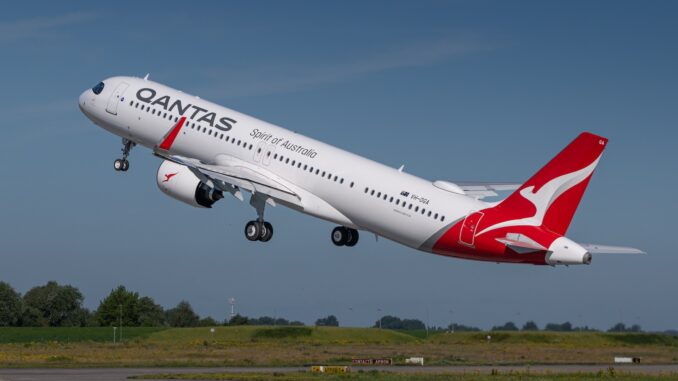
With the A321XLR, Airbus has pushed the operating limits of the single-aisle aircraft significantly further. A range of up to 4,700 nautical miles does not come from an entirely new airframe, but from substantial changes within the A321neo platform.
The additional fuel sits deep inside the fuselage
The key feature is the permanently installed Rear Centre Tank behind the wing. It uses fuselage volume more efficiently than earlier additional container tanks. At the same time, maximum take-off weight rises to 101.5 tonnes. Structure, landing gear, brakes and systems therefore have to handle loads beyond those of conventional A321neo missions.
The platform deliberately remains part of the A320 family
Airlines are intended to operate the XLR largely within existing A320neo infrastructure. The cockpit, maintenance logic and many spare parts remain familiar. This commonality is central to the aircraft’s economics, but it also limits design freedom: long-haul requirements have to be integrated into an existing fuselage and cabin concept.
The Rear Centre Tank is at the heart of the XLR architecture
The A321XLR uses a permanently installed Rear Centre Tank holding roughly 12,900 litres of fuel. Compared with earlier auxiliary container tanks, the integrated solution makes more efficient use of available space. More fuel alone is not enough, however. Maximum take-off weight rises to 101.5 tonnes, landing gear and structure have been adapted, and water and waste capacities must support flights of up to around eleven hours.
Long-haul flying in a narrowbody changes mission planning
An XLR can open routes for which demand is too small to justify an A330 or 787. That shifts network planning away from a small number of large hubs and toward more direct connections. Technically, ETOPS requirements, crew-rest provisions, reserve fuel, catering and cabin comfort all become more important. A single-aisle aircraft does not become a long-haul aircraft merely because more fuel is installed.
Commonality with the A320 family is the economic lever
Airbus deliberately developed the XLR as an evolutionary derivative. For operators with an A320neo fleet, pilot training, many spare parts and maintenance processes remain familiar. This commonality is a major part of the business case. The engineering challenge is to enable a far more demanding mission without losing the advantages of the existing platform.
Engineering under real operating constraints
The XLR demonstrates that range in the single-aisle segment is fundamentally an integration problem. The additional weight has to be accelerated, stopped and carried through turbulence; emergency exits, cabin services and evacuation requirements remain tied to the A321 platform. The combination of high commonality and a new mission is the real engineering achievement.
The Rear Centre Tank changes more than range
The defining feature of the A321XLR is the permanently integrated Rear Centre Tank in the fuselage behind the wing. Compared with removable auxiliary tanks, it allows fuel to be carried more efficiently in terms of both volume and mass. Integration is demanding, however: a large fuselage tank affects structure, fire protection, crashworthiness, pipe routing and maintenance.
This area therefore became an important part of the certification effort. Additional protective measures had to be demonstrated for the XLR to address the consequences of a possible fire or a hard landing. It is a good illustration of why “more range” in a commercial aircraft never simply means installing a larger tank.
Long-haul flying with a single aisle
With an Airbus-advertised range of up to around 4,700 nautical miles, the XLR enters a segment once commonly served by the Boeing 757 or smaller widebodies. Its economic appeal lies in lower capacity: an airline can launch a long route with fewer seats and serve demand that would not fill an A330 or 787.
Technically, however, the XLR remains part of the A320 family. That is both the programme’s achievement and its limitation. Cabin cross-section, the single aisle and restricted underfloor volume do not change with range. The XLR therefore extends the mission envelope of a single-aisle aircraft without turning it into a widebody.
Image: Airbus