
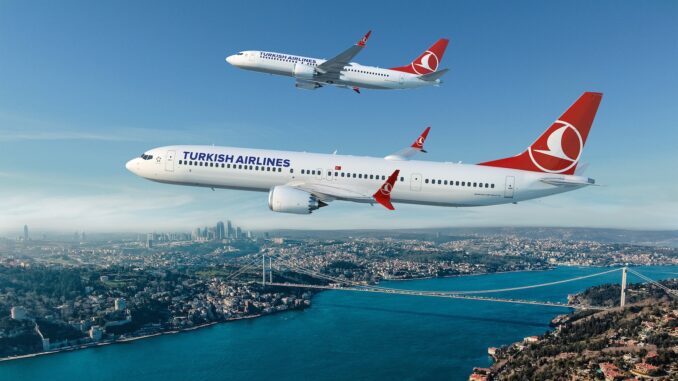
Turkish Airlines has placed a firm order for 100 Boeing 737-8s and secured options for another 50 aircraft from the 737 MAX family. Boeing announced the agreement on September 23, 2026. The deal also includes substitution rights for the larger 737-10. The background to the order is particularly noteworthy: negotiations over maintenance terms for the CFM engines had delayed the deal and apparently remained unresolved when the aircraft order was announced.
Up to 150 737 MAX Aircraft
Turkish Airlines and Boeing had been negotiating the order since 2025. With 100 firm 737-8 orders, the agreement represents the Turkish carrier’s largest-ever narrowbody order with Boeing, according to the two companies.

The additional 50 options are not firm orders. They give Turkish Airlines the opportunity to expand the fleet at a later stage. The agreement also includes substitution rights for the 737-10, allowing the airline to switch aircraft within the agreement to the larger MAX variant and adjust its capacity mix accordingly.
Neither Boeing nor Turkish Airlines has provided a specific delivery schedule or order value in their announcements.
LEAP-1B Is the Sole Engine for the 737 MAX
Engine maintenance played a significant role in the negotiations. The Boeing 737 MAX is offered exclusively with the CFM International LEAP-1B. Unlike aircraft families with multiple engine options, choosing the 737 MAX therefore also means choosing this particular engine.
This matters when assessing the economics of a large fleet order. In addition to aircraft acquisition, operators face substantial engine maintenance and overhaul expenses throughout the service life of an aircraft. The terms agreed for these services can therefore affect the fleet’s long-term operating costs.
Turkish Airlines already operates the LEAP-1B. Its fleet includes both the Boeing 737 MAX 8 and MAX 9. The carrier’s narrowbody fleet also includes aircraft from the Airbus A320 family, including the A321neo.
Turkish Airlines and CFM Already Have a Long-Term Maintenance Agreement
The negotiations surrounding the new order come against the background of an existing maintenance relationship with CFM. In 2021, Turkish Airlines signed a 15-year rate-per-flight-hour agreement covering its LEAP-1B engines. The agreement covers 150 engines powering 75 Boeing 737 MAX aircraft.
Under this type of contract, maintenance costs are calculated according to actual engine flight hours. According to CFM, the agreement guarantees maintenance costs on a dollar-per-engine-flight-hour basis over the term of the contract. For the airline, this provides a predictable long-term cost structure for engine maintenance.
The current negotiations concern the new MAX order. The specific terms sought by Turkish Airlines and the precise points of disagreement with CFM have not been disclosed publicly in detail.
Maintenance Agreement Was Still Pending
According to Aviation Week, differences over the maintenance agreement sought by Turkish Airlines from CFM had delayed completion of the Boeing order. The publication also cited an earlier Reuters report from September 15 stating that Turkish Airlines had considered not proceeding with the planned order because of the dispute.
When the aircraft order was signed, however, the engine maintenance agreement apparently had not yet been finalized. A Turkish Airlines spokesperson told Aviation Week on September 23 that there was no announcement concerning the engines at that point and that the airline would provide information once it became available.
Aircraft procurement and negotiations over long-term engine support were therefore proceeding on separate tracks, at least when Boeing announced the order: the aircraft purchase had been finalized, while no new agreement had yet been announced for a significant component of the fleet’s future lifecycle costs.
737-10 Adds Flexibility
The substitution rights for the 737-10 give Turkish Airlines additional flexibility in selecting the MAX variant. The 737-10 is the largest member of the family. Turkish Airlines can therefore adjust the capacity mix within the agreed order without switching to a different aircraft family.
The new order will join an already mixed narrowbody fleet. In addition to the Boeing 737 MAX 8 and MAX 9, Turkish Airlines operates earlier 737 variants as well as aircraft from the Airbus A320 family, including the A321neo.
It remains unclear how many of the 100 firm aircraft will ultimately enter the fleet as 737-8s or 737-10s, and whether Turkish Airlines will exercise its options for another 50 MAX aircraft.
Sources: Boeing, Turkish Airlines, Aviation Week, CFM International
Images: Boeing