
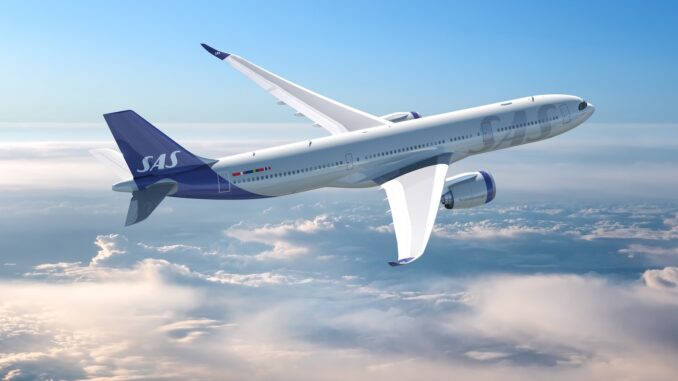
There is more than one correct answer to the question of how much an aircraft weighs. A commercial aircraft has defined empty, operating, take-off, landing and zero-fuel weight limits; during a long-haul flight, its mass may fall by many tonnes simply because fuel is being burned.
MTOW is only one of several limits
Maximum Takeoff Weight describes the highest structurally approved take-off mass of a particular variant. Maximum Landing Weight and Maximum Zero Fuel Weight impose different limits for other flight phases and load distributions. The mass that can actually be used also depends on runway length, temperature, wind and obstacle clearance.
Payload and range compete with each other
Passengers, baggage and cargo share the available mass with fuel. On very long sectors, fuel requirements increase; beyond a certain point, payload has to be reduced to make room for additional fuel within the permitted mass. This relationship is shown in payload-range diagrams and says far more about real capability than a single published range figure.
Aircraft weight is not constant during a flight
Between pushback and landing, a long-haul aircraft can lose many tonnes as fuel is consumed. That is why limits other than MTOW exist. Maximum Landing Weight protects the structure and landing gear from excessive landing loads, while the zero-fuel limit constrains wing bending moments when too much payload is concentrated in the fuselage and too little fuel mass remains in the wings to counteract it.
Why fuel in the wing is structurally advantageous
A large proportion of the fuel in commercial aircraft is stored in wing tanks. This does more than free space in the fuselage. In flight, the fuel mass partly counteracts the upward lift force and therefore reduces the bending moment at the wing root. As fuel is burned, that load distribution changes. Fuel management is therefore also a structural-mechanics issue.
One kilogram less can matter over an aircraft’s lifetime
Lightweight design is often associated with spectacular carbon-fibre structures, yet many programmes save mass in much smaller increments: thinner wiring, optimised brackets, lighter seats or additively manufactured components. Across thousands of flights, every kilogram that is carried permanently translates into additional fuel use. The life-cycle view is what matters, however: an extremely light component that needs frequent repair may be economically worse than a slightly heavier but more robust solution.
The real limit is set by the whole system
Weight limits are translated into specific performance calculations for every flight. On a short or hot runway, the permissible take-off mass may lie below the structural MTOW. Engine performance, brake energy or obstacle clearance can then become the limiting factor. A figure in a data sheet is therefore an upper structural limit, not necessarily the mass that can be used on a given day.
An example shows the scale involved
A long-haul airliner may weigh well over 200 tonnes at take-off, whereas a typical single-aisle aircraft is more likely to be in the region of 70 to just over 100 tonnes. A light aircraft, by contrast, may weigh around one tonne or less. Asking “How much does an aircraft weigh?” without specifying the type is therefore rather like asking for the weight of a road vehicle without distinguishing between a motorcycle and an articulated truck.
Even the same aircraft type can leave the gate at very different masses. A short European sector needs far less fuel than a flight close to maximum range. Passenger numbers, cargo, weather reserves and the required alternate airport also matter. Flight planning is therefore always an exercise in mass management.
Mass affects more than fuel consumption
Higher mass requires more lift. In a given configuration, the aircraft must therefore fly faster or operate at a higher lift coefficient. This influences take-off distance, climb performance and landing speed. Structurally, mass is just as important: wing, landing gear and fuselage must withstand the corresponding loads with the required safety margins.
Weight limits are therefore not abstract paperwork. They connect aerodynamics, structure, engine performance and airport conditions. On a hot day at a high-elevation airport, an aircraft may have to depart below its structural MTOW because available thrust or runway length sets a lower practical limit.
Read more:
Empty Weight vs. MTOW: Which Aircraft Weight Figures Really Matter?
How Much Does a Boeing 737 Weigh? Comparing the 737-800 and 737 MAX
How Much Does an Airbus A320 Weigh? Key A320neo Weight Figures Explained
Image: Airbus