
Translation note: This article was translated with the assistance of AI.
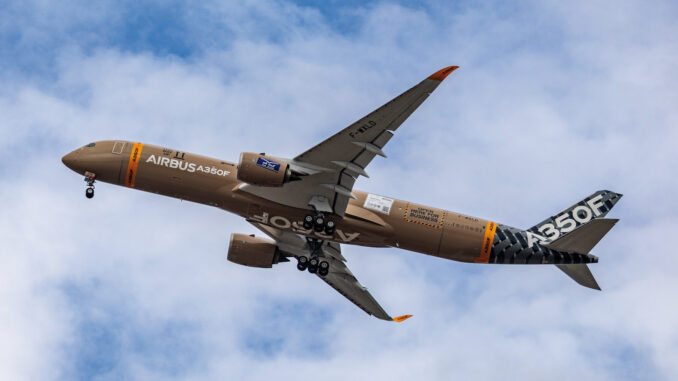
The Airbus A350F completed its maiden flight on September 29, 2026, powered by two Rolls-Royce Trent XWB-97 engines. The flight marks a new application for the engine, which has been operating on the passenger-configured A350-1000 since 2018 and will now also power the freighter version of the A350 family.
The first flight-test aircraft, MSN 700, took off from Toulouse and remained airborne for four hours and ten minutes, reaching an altitude of 25,000 feet. During the flight, the crew assessed basic airworthiness, handling characteristics, and key aircraft systems. The flight marked the start of the A350F certification test campaign.
Trent XWB-97 Builds on A350-1000 Experience
Rolls-Royce is the exclusive engine supplier for the A350F. The Trent XWB-97, the most powerful variant of the Trent XWB family, delivers a maximum thrust of approximately 97,000 pounds-force (431 kN). The engine was not developed specifically for the freighter: It has been in commercial service on the A350-1000 since 2018.
According to Rolls-Royce, the Trent XWB-97 has accumulated more than 4.5 million engine flight hours over eight years of operation. This established service record provides a substantial base of operational experience as Airbus introduces its new freighter.
Rolls-Royce is also continuing to improve the engine’s durability. Two of three planned enhancement packages have already been implemented. A third package, scheduled to enter service in 2028, is expected to double time on wing under demanding operating conditions and increase it by 50% under less demanding conditions. Time on wing refers to the period an engine can remain installed on an aircraft before requiring removal for maintenance.
A350F Enters Flight Testing
The A350F is derived from the A350 family but features a fuselage configuration adapted for cargo operations, including a large main-deck cargo door. Airbus specifies a maximum payload of up to 111 metric tons and a range of up to 8,700 kilometers (4,700 nautical miles).
Despite its close relationship with the A350-1000, the freighter requires an extensive flight-test program. Airbus plans a campaign lasting approximately ten months and totaling around 400 flight hours across two test aircraft. The European Union Aviation Safety Agency (EASA) is already involved in the certification process. Type certification has not yet been granted.
The second prototype, MSN 701, was already at an advanced stage of final assembly when the first aircraft took to the air.
Airbus Reports 115 A350F Orders
At the end of August 2026, Airbus reported 115 A350F orders from 14 disclosed customers. Rolls-Royce referred to more than 100 aircraft on order in its announcement.
The new freighter enters a market in which many older widebody cargo aircraft will need to be replaced over the coming years. These include Boeing 747-400F aircraft, which have been in service since the 1990s. In the market for newly developed large freighters, the A350F will compete primarily with the Boeing 777-8 Freighter.
For Rolls-Royce, the A350F also extends the Trent XWB-97’s application into the large freighter segment. The manufacturer already has a presence in the cargo market through the Trent 700, which powers a substantial share of converted Airbus A330ceo freighters, according to the company. Rolls-Royce expects global demand for approximately 1,600 widebody freighters over the next 20 years.
Image: Airbus