
Translation note: This article was translated with the assistance of AI.
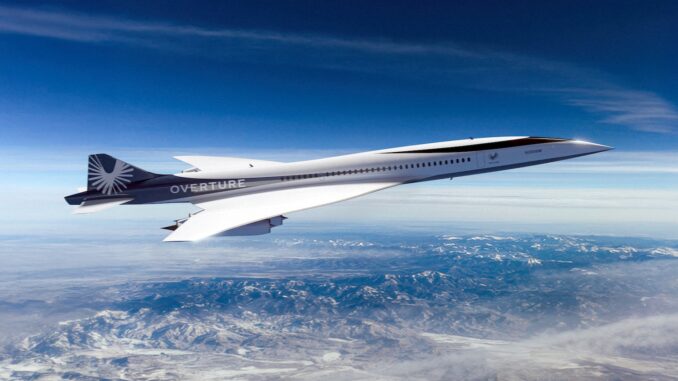
U.S. aerospace company Boom Supersonic has attracted considerable attention in recent years with its plans to revive commercial supersonic air travel—and at least as much skepticism. In early 2025, the company successfully broke the sound barrier with its XB-1 technology demonstrator. Its ultimate ambition, however, is considerably greater. Boom is developing Overture, a passenger aircraft designed to carry 60 to 80 travelers at speeds of up to Mach 1.7. The company also intends to develop the engines needed to power it.
Boom has now reached another milestone with the unveiling of its Sprint Core. The fully assembled gas turbine core will serve as the technological foundation for two products with different applications: the Symphony aircraft engine for the planned Overture supersonic airliner and the Superpower stationary gas turbine, designed to generate 42 megawatts of electrical power. Boom is effectively developing a family of gas turbines for two fundamentally different markets.
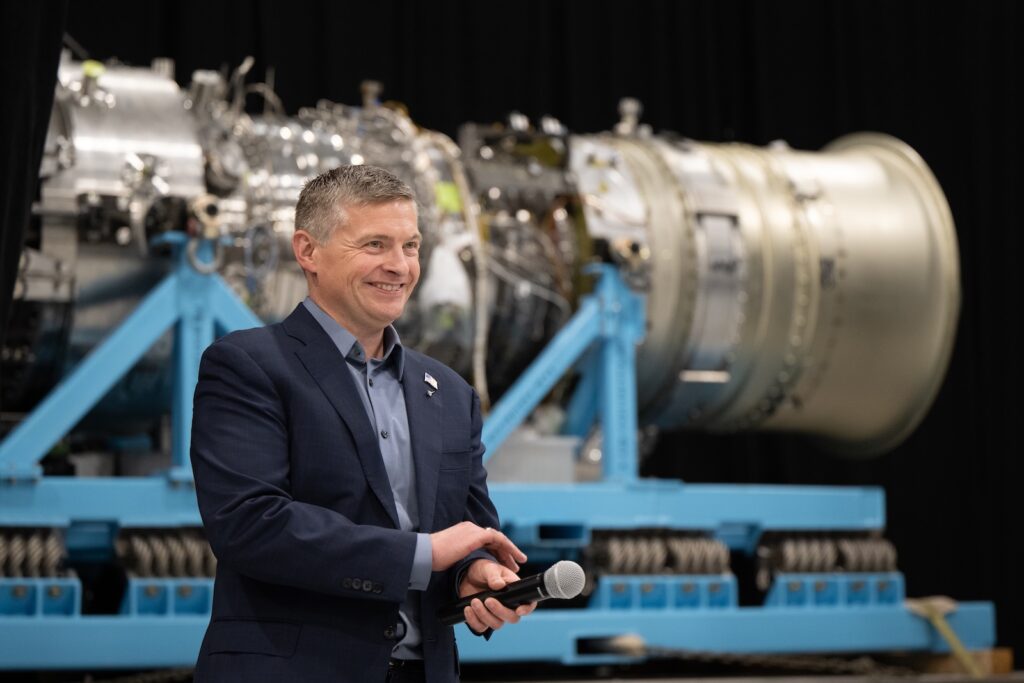
The shared development platform is part of a broader industrial strategy. Boom aims to spread the substantial investment required to develop a new aircraft engine across two business segments. Growing electricity demand from AI data centers is expected to create additional sales opportunities. At the same time, higher production volumes and experience gained from developing stationary gas turbines could also benefit the aircraft engine program.
Sprint Core: The Heart of a New Gas Turbine Family
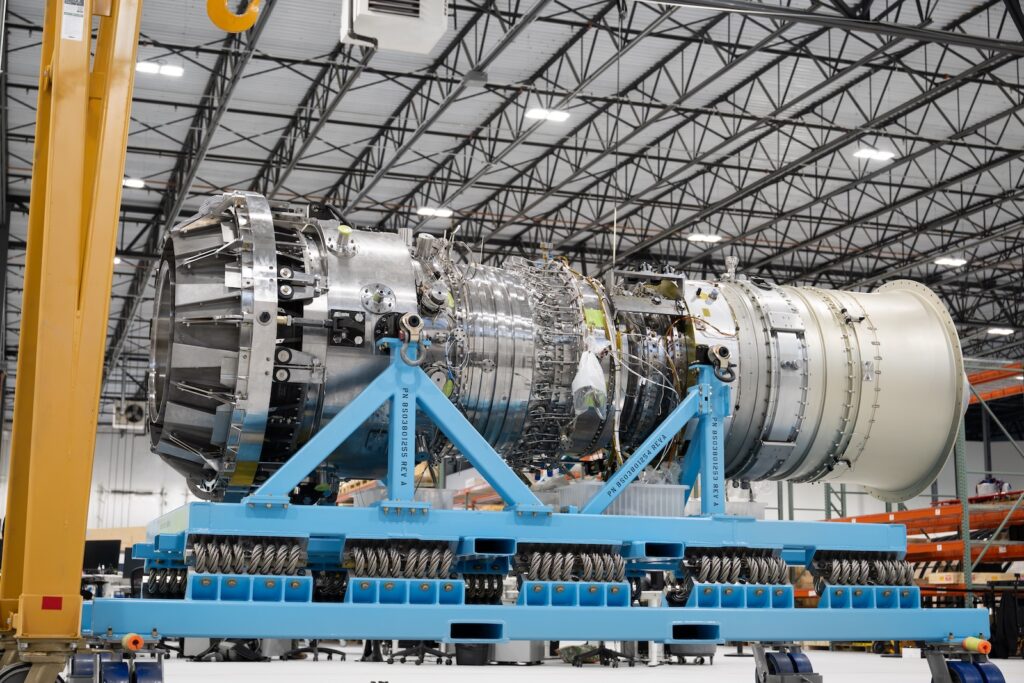
The newly unveiled Sprint Core comprises the essential components of a gas turbine’s thermodynamic core: a high-pressure compressor, combustor and high-pressure turbine.
As in conventional turbofan engines, the six-stage high-pressure compressor increases the pressure of incoming air before it enters the combustor. Fuel is then introduced through 24 fuel injectors and burned. The resulting hot gases expand through a single-stage high-pressure turbine, which extracts part of their energy as mechanical power to drive the compressor. The underlying operating principle has been established for decades.
Deriving stationary gas turbines from aircraft engine technology is also an established industry practice. What distinguishes Boom’s program is therefore not the thermodynamic principle itself, but the parallel development of two new products based on a common core architecture.
The design incorporates integrally bladed compressor disks, known as blisks, in which the disk and blades form a single component. The high-pressure turbine uses hollow blades made from high-temperature superalloys. For the upcoming test campaign, Boom has equipped Sprint Core with more than 1,000 sensors. Including auxiliary systems, the test setup features approximately 2,000 measurement points, according to the company.
These will monitor parameters including temperatures, pressures, mechanical strain and vibration.
The resulting data will be used to validate simulation models against actual test results and refine the design. The first engine core test run is scheduled to take place before Thanksgiving in late November 2026.
Completing the assembly represents an important development milestone. However, it does not yet establish the core’s actual efficiency, durability or reliability.
Symphony Will Power the Overture Supersonic Airliner
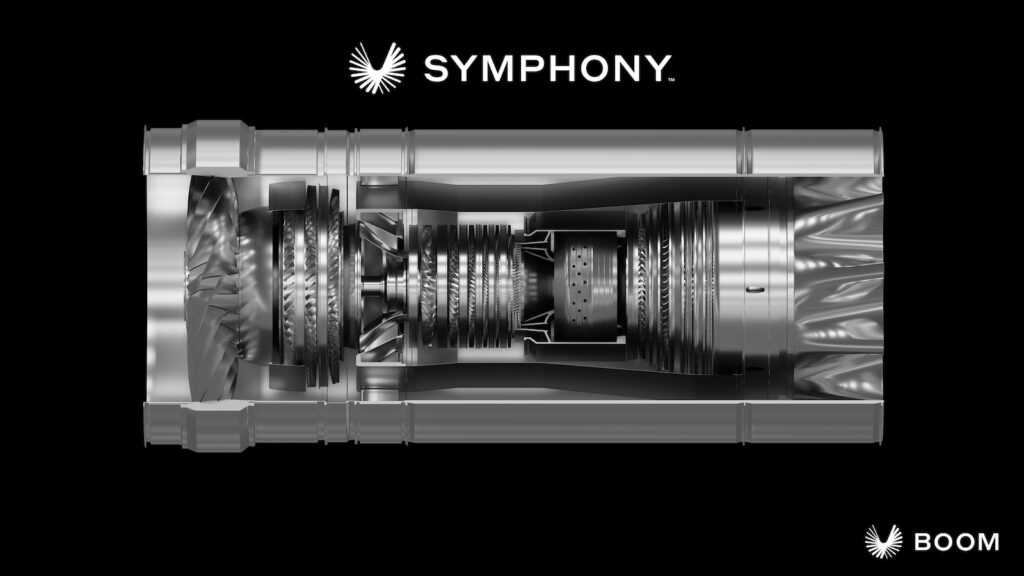
The aviation application of the new core is Symphony, a turbofan engine being developed specifically for supersonic flight. According to published specifications, it is a two-spool turbofan with a medium bypass ratio. More recent company documents place the engine in the 40,000-pound-thrust class, equivalent to approximately 178 kilonewtons.
Symphony is designed to operate without an afterburner. Key design features include an inlet optimized for supersonic speeds and a variable-geometry exhaust nozzle. Both are essential for managing airflow and engine operation across different flight conditions.
Four Symphony engines are intended to power the planned Overture airliner. Boom is targeting a cruise speed of Mach 1.7, a range of approximately 4,250 nautical miles and a passenger capacity of 60 to 80.
Unlike the experimental XB-1 technology demonstrator, Overture is intended for commercial passenger service. Boom plans to manufacture the aircraft itself and has already established a final assembly facility at Piedmont Triad International Airport in Greensboro, North Carolina.
The Overture Superfactory, which opened in June 2024, is designed for an initial production capacity of 33 aircraft per year. Established aerospace suppliers, including Aernnova, Aciturri and Leonardo, are involved in the development and manufacturing of major aircraft components. Some of the industrial infrastructure is therefore already in place, although a complete Overture prototype has yet to be publicly unveiled.
The originally planned start of production has also been delayed.
In October 2026, Boom founder Blake Scholl told the Denver Business Journal that he hoped Overture would begin carrying passengers in 2030. Reaching that milestone will require completion of the aircraft, development and certification of the Symphony engine, and an extensive flight test program.
Why Rolls-Royce Withdrew From the Supersonic Program
Boom did not originally intend to develop the aircraft engine entirely on its own. Beginning in 2020, the company worked with Rolls-Royce to explore possible propulsion solutions for Overture. In September 2022, Rolls-Royce ended the collaboration. The British engine manufacturer explained that the commercial supersonic aviation market was not a strategic priority at the time.
Boom subsequently decided to develop Symphony under its own leadership. “Well, if something really matters, we should just do it ourselves,” company founder Blake Scholl told the Denver Gazette on October 22, 2026.
Major engine manufacturers have considerable experience with supersonic propulsion. GE Aerospace, for example, supplies engine technology for NASA’s X-59 research aircraft, while Pratt & Whitney and Safran have extensive expertise in military supersonic flight.
Developing a new commercial supersonic engine, however, would require substantial development costs to be recovered from a relatively small potential market. Additional expenses would include certification, serial production and long-term product support.
Boom nevertheless sees sufficient market potential. The company identifies more than 600 potential routes for Overture, including transatlantic connections such as New York–London. Flight times on this route are expected to be significantly shorter than those of today’s commercial aircraft. The target market primarily consists of time-sensitive premium travelers, with Boom aiming to offer fares comparable to current business-class tickets.
United Airlines, American Airlines and Japan Airlines are among the carriers that have expressed concrete interest in the aircraft. Purchase agreements and options have been announced, although their fulfillment depends, among other factors, on the aircraft meeting its performance requirements and obtaining certification.
Superpower: Gas Turbine Technology for AI Data Centers
Alongside the aircraft engine, Boom is developing Superpower, a stationary natural gas turbine designed to deliver 42 megawatts of electrical power.
Superpower is primarily intended for large data centers. As AI infrastructure expands, so does the demand for reliable electricity supplies. Stationary gas turbines can provide on-site power generation, particularly where the necessary grid connections cannot be made available in time.
According to Boom, Superpower and Symphony are expected to share approximately 80% of their hardware. Despite these common components, their operating requirements differ considerably. Aircraft engines are designed to achieve a favorable thrust-to-weight ratio while operating across a wide range of flight conditions. For stationary gas turbines, continuous operation, efficiency, availability and maintenance intervals are among the primary considerations.
Superpower is therefore a separate industrial development program within Boom. The gas turbine has yet to demonstrate that it can meet its intended performance targets.
New Manufacturing Capacity in Colorado
Alongside the Sprint Core unveiling, Boom announced the expansion of its gas turbine manufacturing operations in Centennial, Colorado. The Superpower Superfactory comprises two buildings with a combined floor area of approximately 18,600 square meters, or 200,000 square feet. The company estimates the investment at $150 million.
Individual turbine components are already being manufactured at the site. Future production is expected to include compressor and turbine blades, shafts and casings. Boom plans to manufacture components in-house that account for approximately 85% of the finished product’s mass.
One of the most technically demanding projects is establishing in-house manufacturing capabilities for single-crystal turbine blades. These components are used in high-pressure turbines because their material structure enables them to withstand extreme temperatures and high mechanical loads. Boom intends to manufacture them using a largely digitized casting process. The first such components are expected to become available in 2027.
For Superpower, the company is targeting annual production of 25 gas turbines in 2028 and 50 in 2029. At a rated electrical output of 42 megawatts per unit, the latter would represent approximately 2.1 gigawatts of newly manufactured generating capacity per year.
$1.25 Billion Agreement With Crusoe Terminated
The industrial rollout is closely linked to the commercial development of the Superpower program. In December 2025, Boom announced data center developer Crusoe as its first major customer. The planned agreement covered 29 gas turbines with a combined electrical output of approximately 1.21 gigawatts. The order was valued at around $1.25 billion.
However, in September 2026, it emerged that the two companies had ended their partnership. Crusoe confirmed that it still intended to use gas turbines for its power supply, but not those developed by Boom. No specific reasons for the decision were publicly disclosed.
Boom is maintaining its production plans and points to additional prospective customers. However, the extent of its currently binding purchase commitments cannot be conclusively determined from the information published to date.
Another industrial relationship exists with energy technology company Baker Hughes. In February 2026, Baker Hughes announced an order for additional electrical generators for the Superpower program. At that time, the announced orders covered a total of 31 generators. It remains unclear to what extent the termination of the Crusoe agreement will affect their fulfillment.
Technical Progress, but Crucial Demonstrations Still Ahead
With Sprint Core, Boom now has a fully assembled prototype of the gas turbine core intended to underpin two separate product programs. Ongoing component manufacturing and existing industrial partnerships demonstrate that the effort has progressed beyond the conceptual stage.
Boom has also gained practical experience in aircraft development. After its first flight in March 2024, the company successfully broke the sound barrier with its XB-1 technology demonstrator in January 2025.
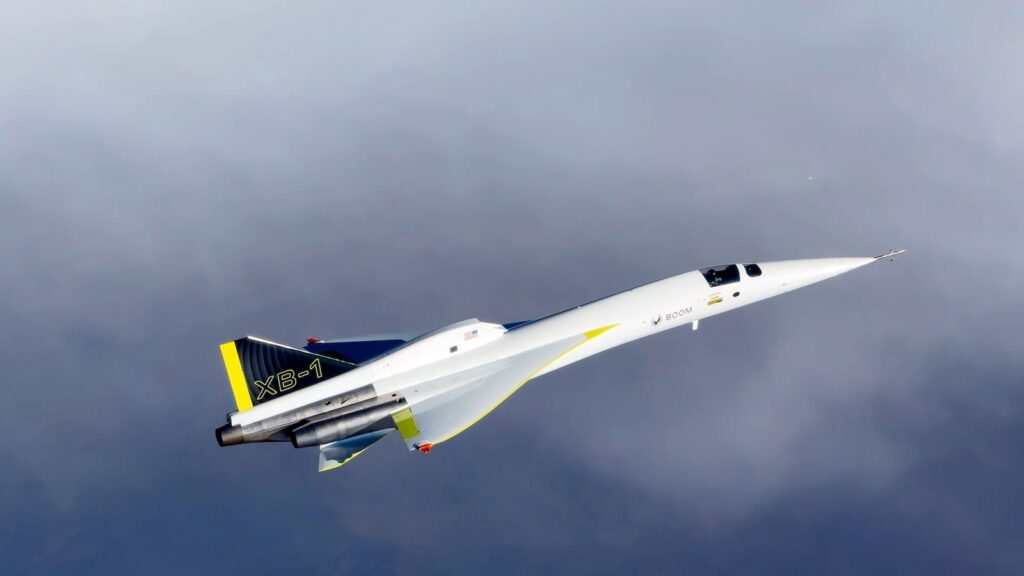
However, the relevance of these tests to the much larger Overture passenger aircraft is limited. In a May 2025 interview with airliners.de, aerospace engineer Dr. Bernd Liebhardt of the German Aerospace Center (DLR) stated that XB-1’s flights had not demonstrated any fundamentally new technical capabilities beyond those known for decades.
Liebhardt expects the introduction of a new commercial supersonic aircraft to take considerably longer than Boom originally anticipated.
Furthermore, XB-1 is equipped with different engines. Its flight tests therefore provide no direct evidence of the performance capabilities of the newly developed Symphony engine.
The crucial technical demonstrations for Sprint Core and Symphony are still ahead. Only the upcoming ground tests will show how the new core architecture performs under actual operating conditions. Symphony will also require development of the complete aircraft engine, extensive testing and certification by the relevant aviation authorities.
Whether the shared technology platform can reduce development costs and strengthen the economic foundation of Overture will depend on Boom meeting its technical objectives and successfully establishing the planned serial production capabilities.
Images: Boom