
Translation note: This article was translated with the assistance of AI.
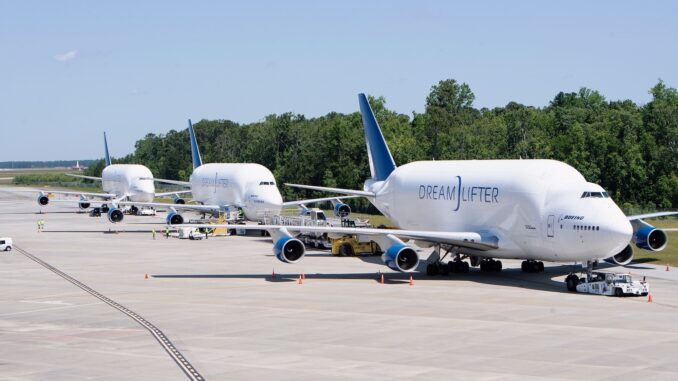
The Boeing 747 Dreamlifter transports large aircraft components that cannot fit inside conventional cargo aircraft. To accommodate these oversized structures, four former Boeing 747-400 passenger jets were extensively modified. Featuring an enlarged fuselage and a rear section that swings open sideways, the specialized freighters connect international Boeing 787 production facilities with final assembly operations in the United States.
Why Boeing Needed a Dedicated Freighter for the 787
When developing the Boeing 787 Dreamliner, Boeing adopted a globally distributed manufacturing strategy. Large fuselage sections and wings are produced by specialized suppliers before being transported to the final assembly facility.
The dimensions of these components presented a significant logistical challenge. Large carbon fiber-reinforced polymer (CFRP) fuselage sections, in particular, could not fit inside conventional cargo aircraft. Transporting them by sea would have been possible in principle, but would have resulted in considerably longer delivery times.
Boeing therefore needed an aircraft designed primarily to accommodate exceptionally large cargo. The solution was the 747-400 Large Cargo Freighter (LCF), better known as the Dreamlifter.
How a Boeing 747-400 Became a Specialized Cargo Aircraft
Boeing converted four previously operated 747-400 passenger aircraft into Dreamlifters. The upper fuselage was replaced with a substantially enlarged structure, giving the aircraft its distinctive appearance.
The modification created a cargo compartment with a volume of approximately 1,840 cubic meters (65,000 cubic feet), more than three times that of a conventional Boeing 747-400F. The additional space allows the aircraft to accommodate oversized components. For such shipments, cargo dimensions often become the limiting factor long before an aircraft reaches its maximum payload capacity.
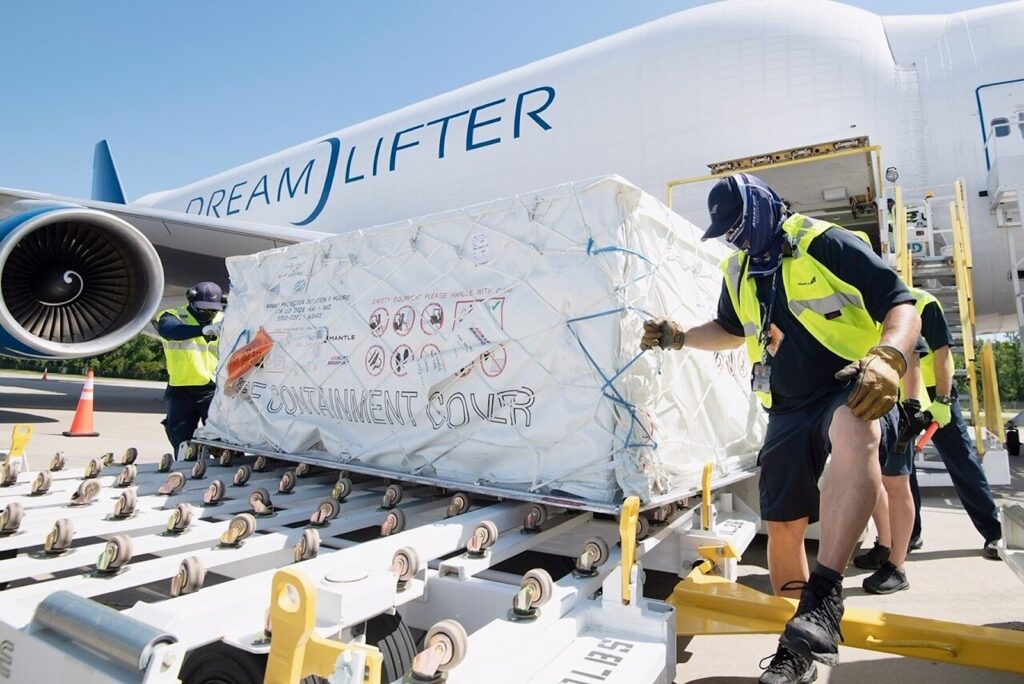
Another distinctive feature is the loading system. Unlike conventional freighters, which typically use large side cargo doors, the Dreamlifter has an entire rear fuselage section that swings open sideways.
This creates a large opening through which fuselage sections and wings can be loaded from the rear. Specially developed cargo loaders raise the components to the height of the cargo floor and transfer them into the aircraft.
How the Enlarged Fuselage Affects Aircraft Design
Creating the oversized cargo compartment required extensive modifications to the original 747 structure. The new upper fuselage had to be integrated with the existing airframe and designed to withstand the loads encountered during flight.
The larger fuselage also changes the aircraft’s aerodynamic characteristics. Its substantially increased cross-sectional area affects drag and airflow around the rear of the aircraft. Engineers therefore had to account for the effects on stability and controllability.
These requirements illustrate a fundamental difference between a conventional freighter and a specialized transport aircraft. Conventional cargo aircraft are designed to accommodate a wide variety of shipments. The Dreamlifter, by contrast, was developed around the dimensions of specific aircraft assemblies.
Four Aircraft Supporting an International Supply Chain
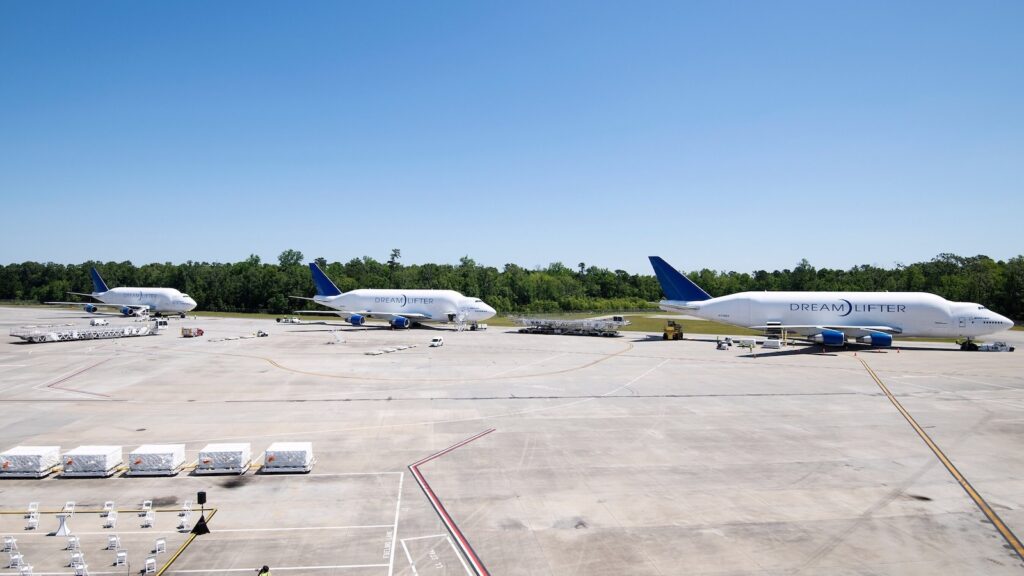
The first Dreamlifter completed its maiden flight on September 9, 2006. A total of four aircraft were converted to support the transport of major assemblies between production sites involved in the 787 program.
Originally, components were transported to Boeing’s final assembly facility in Everett, Washington, among other destinations. Since 2021, Boeing has consolidated 787 final assembly operations in North Charleston, South Carolina.
The Dreamlifter allows large, substantially preassembled aircraft structures to travel long distances without requiring them to be broken down into smaller components. This reduces certain assembly operations at the final production site.
At the same time, the approach places considerable demands on international logistics. Aircraft manufacturing and component transportation must be closely coordinated. A delayed fuselage section can directly affect the production schedule.
The Dreamlifter is therefore a transport aircraft specifically developed around the manufacturing requirements of the Boeing 787. Its design demonstrates how aircraft production processes can influence the development of highly specialized aviation technology.
Images: Boeing