
Translation note: This article was translated with the assistance of AI.
Fiber-reinforced composites used in aircraft cabins must be lightweight and mechanically strong, yet recycling them remains difficult. Researchers have now developed a flame-retardant sandwich composite whose individual components can be separated and recovered after use. The key is a modified epoxy resin. Potential applications include floor panels in passenger aircraft cabins.
The resin system was developed at the Swiss Federal Laboratories for Materials Science and Technology (Empa), a research institution specializing in materials science and engineering. Empa worked with Elantas Europe AG to investigate its suitability for industrial applications. Elantas belongs to the German specialty chemicals group ALTANA and manufactures specialty resins as well as insulation and protective materials. The project received funding from Innosuisse, the Swiss Innovation Agency.
Empa first introduced the underlying recyclable epoxy resin in 2023. In the latest project, the researchers and Elantas explored its potential for industrial use in a multilayer sandwich composite.
Phosphorus-Based Additive Changes the Properties of Epoxy Resin
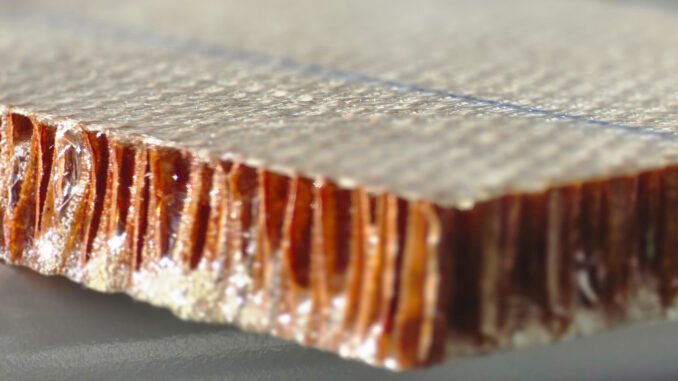
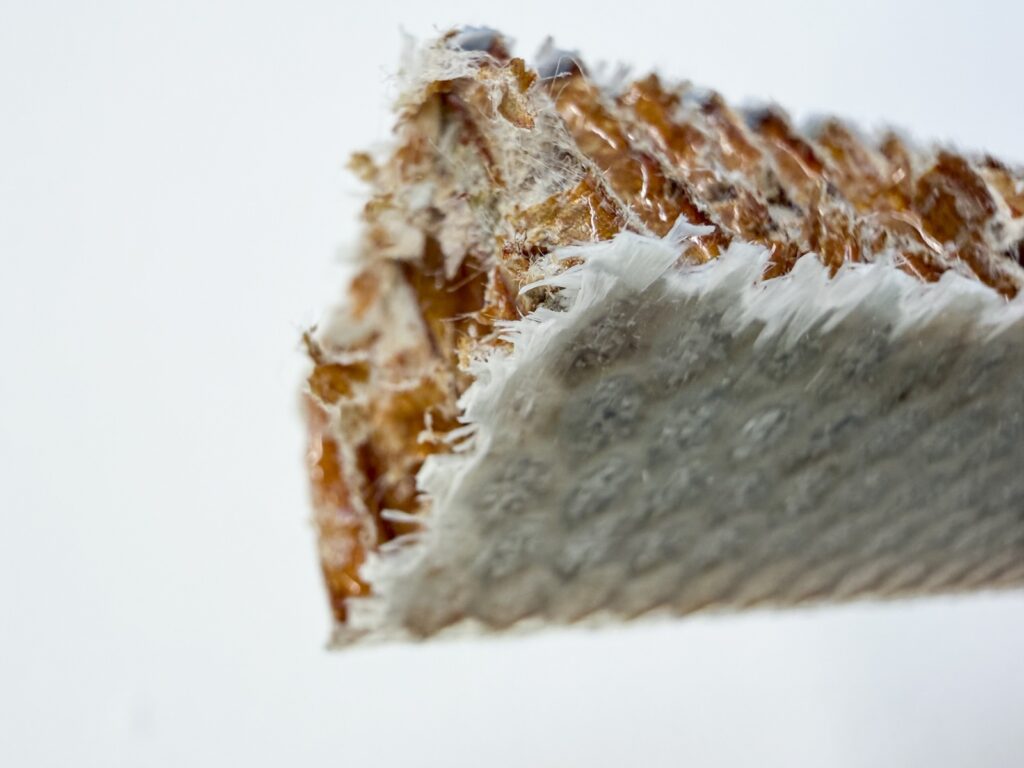
The composite consists of a lightweight honeycomb core made of aramid, a heat-resistant polymer. Several layers of flat-woven glass or carbon fibers are laminated to both sides of the core. Epoxy resin serves as the matrix material, bonding the layers together.
Conventional epoxy resins form permanently cross-linked polymer networks during curing. Once hardened, they cannot simply be melted down or dissolved. “Composites containing epoxy currently end up in landfills or are incinerated,” says Dr. Sabyasachi Gaan of Empa’s Advanced Fibers laboratory.
Gaan’s research team developed a phosphorus-containing additive that changes the properties of the epoxy resin. The molecule is introduced during resin production and provides flame-retardant properties. It also allows the cured material to be softened and reshaped under certain conditions. This process, known as thermomechanical recycling, is not possible with conventional epoxy resins.
Recovering Aramid Honeycombs and Carbon Fibers
To recycle the entire sandwich composite, the researchers use a chemical process. With a suitable solvent and heat, the bonded structure can be separated into its individual components. The honeycomb core and the woven glass or carbon fiber layers can then be recovered separately.
Recovering these materials could also offer economic benefits, particularly because aramid honeycombs and carbon fibers are relatively expensive.
Recycling Aircraft Cabin Components
One step in the recycling process remains unresolved. Although the composite can be separated into its constituent materials, the dissolved epoxy resin has not yet been recovered in this project. Gaan intends to investigate this in future research. A fully closed-loop recycling process for the sandwich composite has therefore not yet been demonstrated.
According to Gaan, the material meets fire safety requirements while retaining mechanical properties close to those of conventional epoxy systems. He says the new resin makes it possible to separate and recycle the composite’s components, an important advance over traditional epoxy-based materials.
Production and Recycling to Be Scaled Up
The technology is still at the research and demonstration stage. The project partners now intend to scale up both composite manufacturing and the chemical recycling process.
Fiorenzo Lenzi, Head of the Aerospace/Ballistic Product Line at Elantas, emphasizes the industry’s need to combine fire protection, lightweight construction, and recyclability. He considers the new epoxy composite system evidence that these requirements can be addressed together.
While Elantas continues to pursue industrial applications for the material, Empa is investigating other potential uses. Future research projects will examine applications in the energy and construction sectors.
Images: Empa