
Translation note: This article was translated with the assistance of AI.
Air France has examined around 4,300 North Atlantic flights to assess whether targeted changes to flight paths can help avoid particularly climate-relevant contrails. A total of 130 flights were actually rerouted during the trial. The tests form part of the European CICONIA research project.
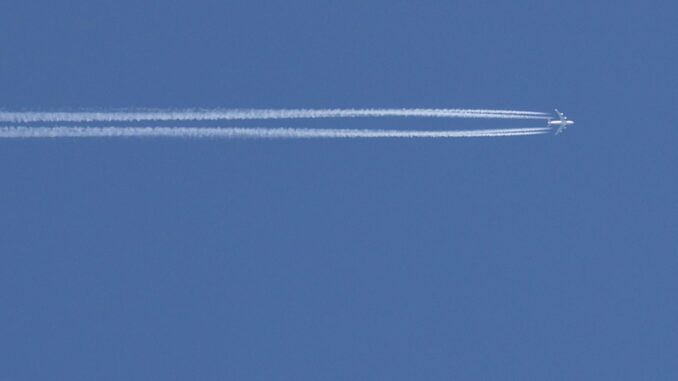
Contrails are among aviation’s so-called non-CO₂ effects. While many of the white trails behind aircraft disappear within minutes, under certain atmospheric conditions they can persist for hours, spread and contribute to additional cirrus cloud formation. These high-altitude ice clouds trap part of the longwave heat radiation emitted by the Earth within the atmosphere. Although they also reflect some incoming solar radiation, the warming effect generally dominates in the case of persistent contrails and the cirrus clouds that can develop from them.
Air France has now investigated in commercial operations whether such persistent and climate-relevant contrails can be reduced through adapted flight planning. Between February and April 2026, almost 4,300 commercial flights over the North Atlantic were included in the trial.
Contrails do not form everywhere
Whether a persistent contrail forms depends heavily on the atmospheric conditions at a given altitude. Particularly relevant are air layers that are both very cold and highly humid. Under these conditions, the ice crystals produced behind an aircraft’s engines can remain in the atmosphere and continue to grow.
Such conditions occur only in limited areas and for limited periods of time. This creates a potential opportunity for flight planning: if a particularly critical air mass can be forecast reliably, aircraft may be able to avoid it by changing altitude or making a lateral adjustment to their route.
The objective is not to prevent every contrail. The focus is on those flights and atmospheric regions where a particularly high climate impact is expected.
130 flights were actually rerouted
For the trial, Air France worked with the French companies Estuaire and Klima. Based on meteorological data, 245 of the almost 4,300 flights examined were identified as having a comparatively high potential climate impact. Alternative flight paths were calculated for these flights.
The route was ultimately changed on 130 flights. Air France used these flights both to validate the underlying forecasting models and to investigate whether such route adjustments can be integrated into real-world long-haul operations.
The results also show how strongly the effect can be concentrated among a relatively small share of flights. According to Air France, three percent of the flights analysed accounted for around 25 percent of the contrail-related climate impact calculated during the trial.
Across all flights examined, Air France says the climate impact associated with contrails was reduced by eight percent. Among the flights that were actually rerouted, the reduction reached 57 percent. For these flights, the calculated overall climate impact, including additional effects, fell by 36 percent. Air France puts the avoided climate impact at around 22,000 tonnes of CO₂ equivalent.
Additional fuel burn must also be taken into account
An alternative flight path is not automatically better for the climate. A longer route or a less efficient altitude can increase fuel consumption and therefore lead to additional CO₂ emissions.
The overall balance is therefore critical: the avoided climate impact of a persistent contrail must outweigh any additional effects caused by the altered flight path.
This is one of the key questions addressed by the European CICONIA research project. Coordinated by Airbus, the project examines how aviation’s non-CO₂ effects can be assessed more accurately and reduced through operational measures. Its work includes improved weather forecasting, models for evaluating climate impact and new operating concepts for airlines and air traffic management. Real-world flight trials aimed at avoiding particularly climate-relevant contrails are another central element.
CICONIA is part of the European SESAR programme
CICONIA is being conducted within the European SESAR research programme. The SESAR 3 Joint Undertaking is a public-private partnership involving the European Union, Eurocontrol and companies and organisations from across the aviation sector. Its work focuses on research and development for European air traffic management and the Digital European Sky.
CICONIA is not limited to contrails. The project is developing an operational concept that can combine weather data, climate models, flight planning and air traffic management. In the longer term, this could allow airlines and air traffic controllers to determine during planning or even during a flight whether an alternative trajectory would provide a better overall climate outcome.
In addition to Airbus and Air France, project partners include Eurocontrol, the German Aerospace Center, Meteo-France, Boeing, NATS, Swiss and several European research institutes and universities. The project has been running since July 2023 and remains in the research phase.
Not yet a procedure for regular operations
The Air France flights should therefore not be seen as the introduction of a new standard flight-planning procedure. The airline explicitly describes the programme as a trial and is following a test-and-learn approach. Within CICONIA, the initial objective is likewise to demonstrate the technical and operational feasibility of such measures.
Air traffic control is another factor. Airlines cannot independently implement planned changes to routes or flight levels. Such adjustments have to be integrated into existing air traffic management and approved by the relevant authorities.
The trials nevertheless illustrate why targeted avoidance of persistent contrails is receiving increasing attention. If the atmospheric regions associated with particularly high climate impacts can be predicted reliably, and if only a relatively small proportion of flights needs to be adjusted, operational changes to flight trajectories could become an additional tool for reducing aviation’s overall climate impact.
Image: DLR / CC BY 3.0