
Translation note: This article was translated with the assistance of AI.
The basic architecture of modern commercial aircraft, with a distinct fuselage and separate wings, dates back to the early days of powered flight. And although new approaches have repeatedly emerged over the decades, surprisingly little has changed in this fundamental configuration. From time to time, alternative concepts such as flying wings or blended wing bodies with integrated wing and fuselage structures have attracted varying degrees of attention. Compared with the conventional layout featuring a largely cylindrical fuselage and clearly separated wings on either side, a more integrated configuration appears to be a serious alternative. Flying wings and blended wing bodies (BWBs) promise a number of theoretical advantages. Yet despite numerous research projects, such concepts have so far failed to establish themselves in civil aviation. Why?
What is a Blended Wing Body (BWB)?
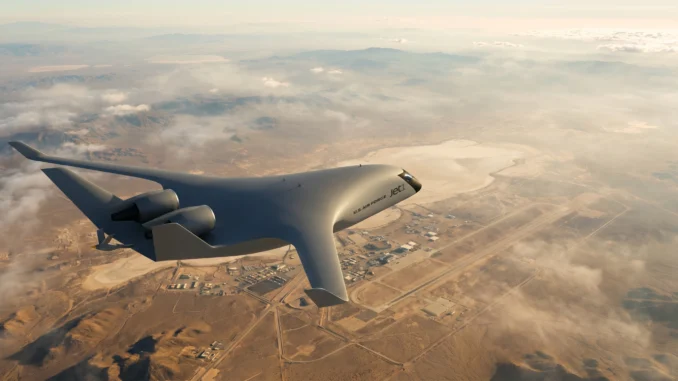
In a conventional commercial aircraft, the fuselage and wings are clearly separated components. In this so-called tube-and-wing configuration, the fuselage primarily serves as usable space and as a pressure vessel, while its contribution to lift is relatively limited. In a blended wing body, or BWB, the fuselage and wings merge smoothly into one another.
This can result in a more favorable lift-to-drag ratio. One of the key theoretical advantages lies in the broad central fuselage section, known as the centerbody, which can itself generate a significant share of the aircraft’s lift.
Strictly speaking, a BWB is not a pure flying wing. In a classic flying-wing configuration, the separate fuselage largely disappears into the wing. A BWB, by contrast, retains a distinct central body that is aerodynamically and structurally blended into the wings. Many BWB designs also dispense with a conventional tail assembly.
Blended Wing Body: Advantages and Challenges
Another advantage is the large usable internal volume provided by the broad, integrated structure. This opens up new possibilities for cabin, cargo, tank and systems concepts. Wider cabin zones or alternative interior layouts, for example, become possible. The additional volume may also be attractive for new energy carriers: liquid hydrogen requires significantly more tank volume than kerosene, and a BWB could in principle provide more space for its integration.
The integrated configuration could theoretically also reduce the number of components and allow structures to perform multiple functions. Engines can be more closely integrated into the airframe as well, for example on the rear centerbody or partially embedded. This could provide additional aerodynamic and acoustic benefits. At the same time, however, requirements for structural design, flight control, engine inflow, maintenance and certification become more demanding.
This is where the trade-offs begin. Each of these theoretical advantages comes at a potential cost. The broad pressurized cabin is considerably more difficult to design structurally, while configurations without a conventional tail impose greater demands on stability and flight control. Cabin layout, evacuation and airport operations also become more complex.
Numerous research programs over the past decades show that these advantages and challenges are more than theoretical considerations. NASA and Boeing, for example, tested a BWB configuration with the X-48 over a total of 122 flights. Airbus later followed with the MAVERIC demonstrator and also investigated the concept as part of its ZEROe hydrogen program. Further work has been carried out by Delft University of Technology and the German Aerospace Center (DLR), among others. Today, JetZero is attempting to bring the BWB architecture to the scale of a commercial aircraft.
NASA and Boeing: X-48 Addresses the Question of BWB Controllability
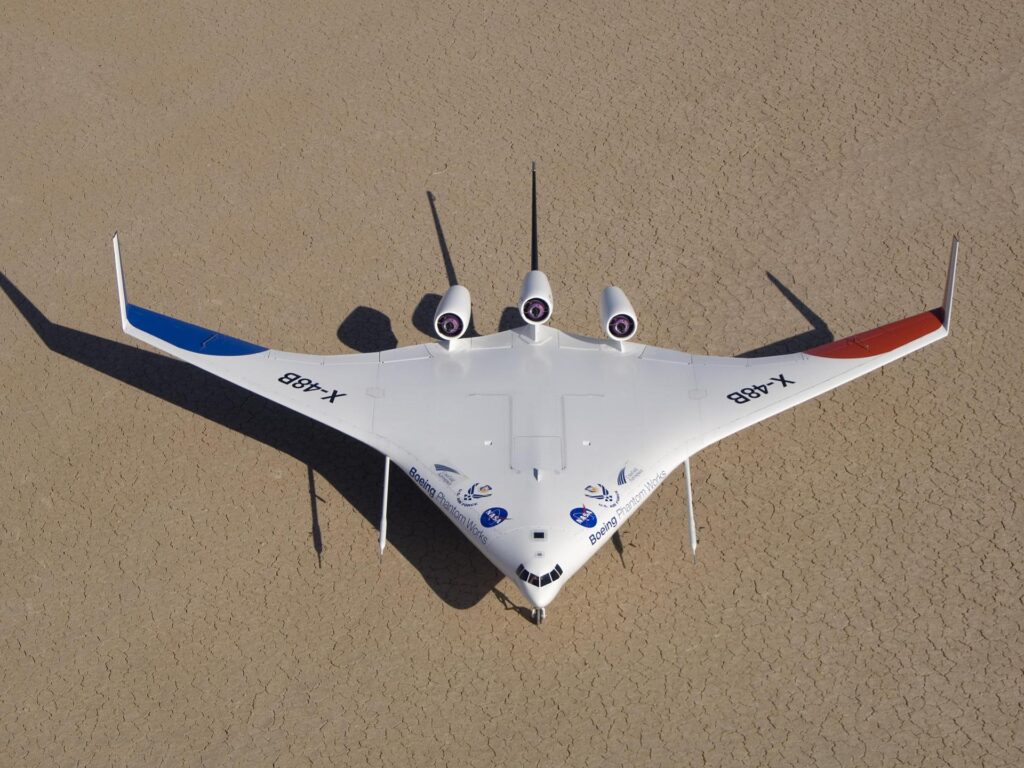
One of the most important research programs was NASA and Boeing’s X-48. The demonstrator was intended primarily to determine whether a BWB configuration could be adequately controlled during slow and therefore particularly demanding phases of flight. The X-48B and X-48C completed a combined 122 flights.
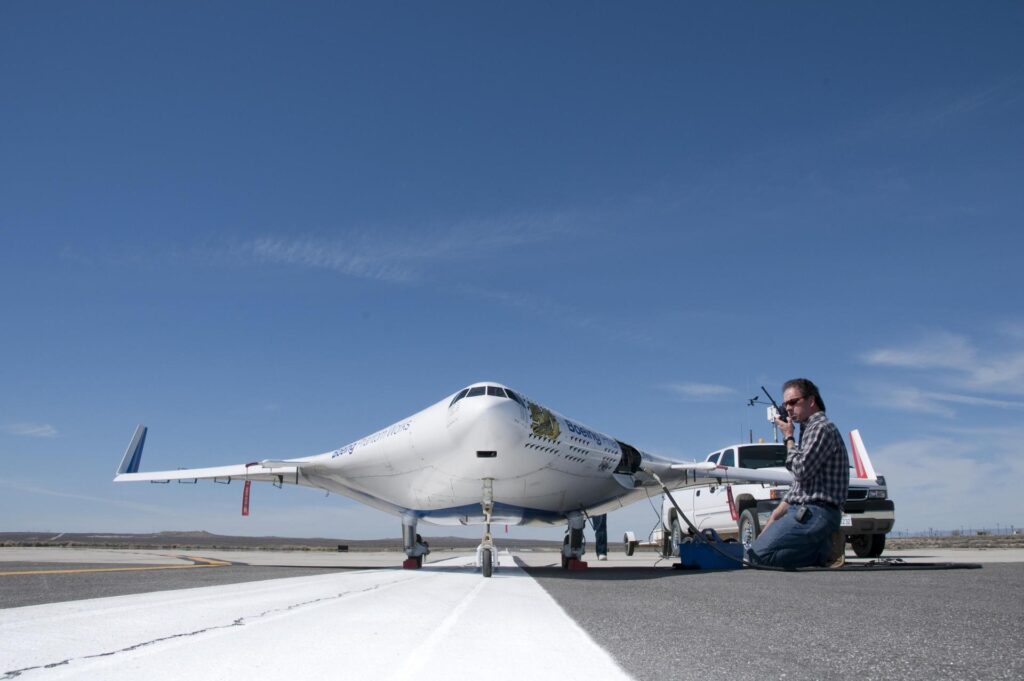
After completion of the program, NASA stated that low-speed controllability had been demonstrated throughout the tested flight envelope. Boeing likewise concluded that a BWB could be controlled during takeoff, landing and other low-speed flight conditions with similar effectiveness to a conventional tube-and-wing aircraft.
This answered one central question, at least for the configuration tested: a BWB does not inherently have to fail because of inadequate controllability. At the same time, the program also illustrates the limitations of such demonstrators. The X-48 was a small-scale research aircraft. It could not answer whether a comparable architecture with a large pressurized cabin, passengers and realistic structural mass would retain the same overall advantages.
Airbus MAVERIC: Aerodynamic Potential
Airbus revisited the concept several years later with MAVERIC. Launched in 2017, the research project used a blended-wing-body demonstrator measuring 2 meters in length and 3.2 meters in width, which flew for the first time in June 2019.
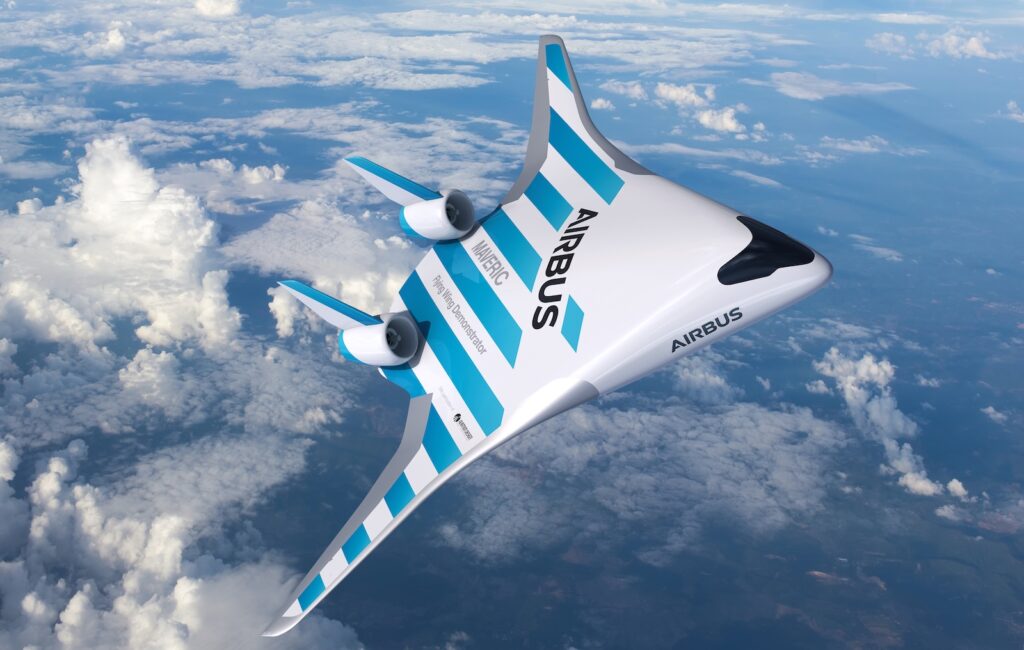
At the time, Airbus estimated that the configuration could potentially reduce fuel burn by up to 20 percent compared with contemporary single-aisle aircraft. The manufacturer also saw additional advantages in the broad, integrated airframe: it offered greater flexibility for alternative propulsion concepts and more freedom in cabin design. Airbus cited wider aisles and more legroom as potential benefits. However, the company did not publish quantified results for these aspects. Flight testing instead focused primarily on areas such as low-speed behavior, stall characteristics, handling and flight control.
Airbus therefore saw considerable potential in the BWB architecture. Nevertheless, MAVERIC has so far not resulted in a specific production program.
Airbus ZEROe: More Space for Hydrogen Thanks to the BWB Architecture?
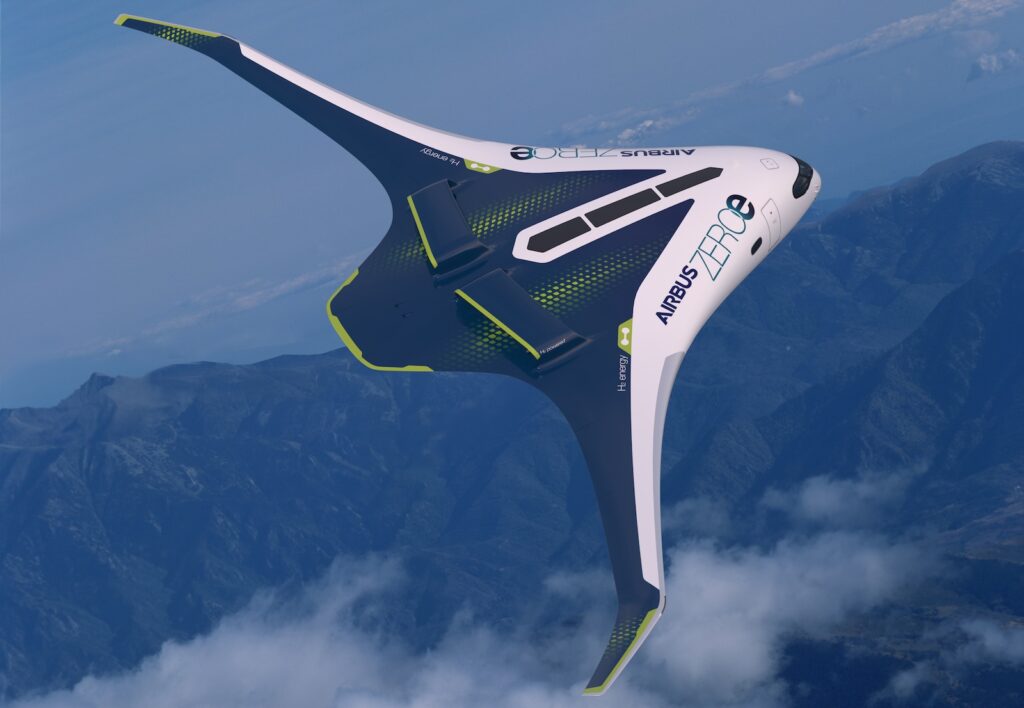
In 2020, Airbus also included a BWB in its ZEROe program. The concept was designed for up to 200 passengers. It was to be powered by two modified gas turbines burning hydrogen directly. Fuel cells were also intended to provide electrical power as part of a hybrid-electric system. Airbus specifically highlighted the unusually wide interior, which offered several options for hydrogen storage and distribution. In the design presented at the time, the liquid-hydrogen tanks were located beneath the wing sections.
The BWB thus remained one of several airframe concepts studied under ZEROe. In later ZEROe designs, Airbus returned to a more conventional aircraft architecture.
TU Delft: Flying-V as a Related Integrated Concept
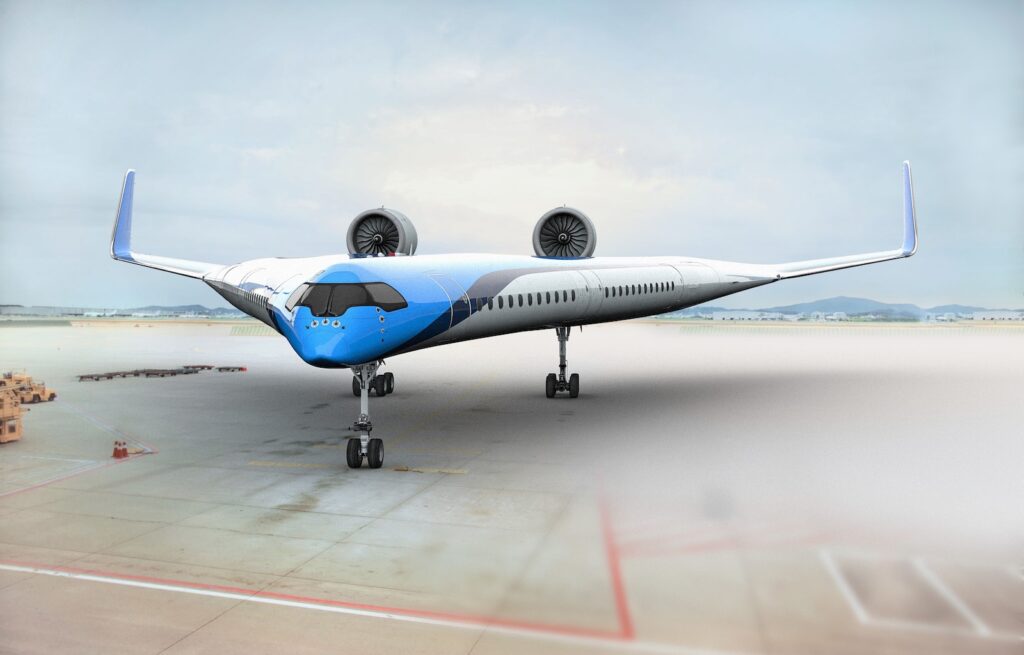
With the Flying-V, Delft University of Technology (TU Delft) in the Netherlands investigated and further developed a related integrated aircraft concept in several studies. Unlike a conventional BWB, the passenger cabins and cargo holds are located inside two V-shaped wing bodies.
A performance analysis compared the Flying-V with a conventional reference aircraft in the size class of an Airbus A350-1000. In this study, maximum trimmed aerodynamic efficiency was around 17 percent higher. The Flying-V also performed significantly better than the A350-1000-like reference aircraft in terms of calculated cruise range efficiency. At the same time, the Flying-V required a greater pitch angle during approach, increasing the area ahead of the aircraft obscured from the cockpit.
Investigations of low-speed handling also identified particular characteristics in terms of stability, control and pilot workload. Active flight control was able to improve the aircraft’s behavior. The studies therefore paint a differentiated picture: the Flying-V can achieve significantly higher aerodynamic efficiency, but at the same time places greater demands on visibility, low-speed handling and flight control.
DLR: BWB as a Research and Comparison Concept
The German Aerospace Center has also continued to investigate the BWB. In 2025, DLR presented the D150-BWB, a concept featuring a broad, flat fuselage and two engines mounted on top of the airframe. The D150-BWB is not an announced production program but a research and comparison concept. The BWB is assessed alongside other aircraft and propulsion architectures.
DLR cites good aerodynamic characteristics, large cargo volumes and the potential for acoustic shielding of the engines among the advantages. At the same time, it identifies unresolved design issues and lower passenger comfort as challenges. While the broad cabin provides substantial space, it can also lead to unusual seating and cabin layouts.
China: NPU-BWB-300 as a Flying BWB Demonstrator
China has also been researching blended-wing-body configurations for years. One important player is Northwestern Polytechnical University (NPU) in Xi’an, which has developed several BWB designs together with Chinese aircraft manufacturer COMAC and other research partners. These include the NPU-BWB-300, designed for around 300 to 330 passengers, which has been used to investigate areas including aerodynamics, stability and control, cabin design and engine integration.
The program reached an important milestone in 2023, when a 10.3-percent-scale model of the BWB-300 completed an autonomous flight. NPU has continued its work on BWB technologies since then, including structural design, noise reduction and concepts involving electric and hydrogen-based propulsion. However, the research has not yet resulted in a specific COMAC production program for a BWB commercial aircraft.
JetZero: Blended Wing Body at Full Scale
JetZero is currently considerably closer to potential commercial implementation. The planned Z4 is intended to carry around 250 passengers over distances of up to 5,000 nautical miles. Notably, JetZero initially plans to use conventional engines, meaning that the efficiency gains are intended to come primarily from the aircraft architecture itself. The company says the Z4 could use up to 50 percent less fuel than comparable tube-and-wing aircraft. This figure remains a manufacturer target and has not yet been demonstrated in Z4 flight operations.
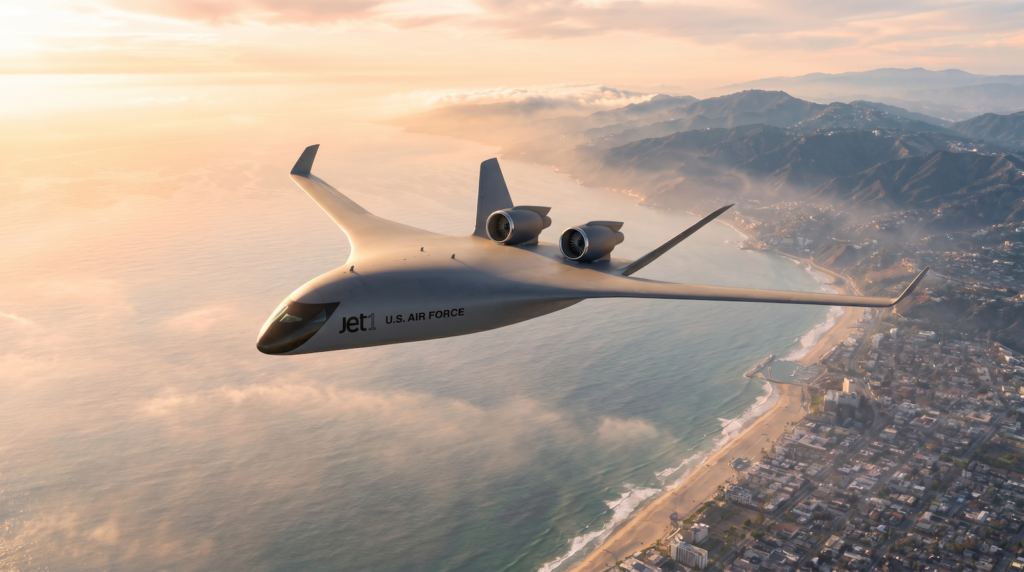
The key next step is the full-scale Jet1 demonstrator, which is being built together with Scaled Composites and is scheduled to fly for the first time in 2027. In parallel, JetZero has already built five generations of smaller Pathfinder aircraft and tested them in more than 30 flights. According to the company, the latest tests have served, among other things, to validate the configuration and flight-control system for Jet1.
At the same time, JetZero is already preparing for industrialization. In June 2026, construction began on a production and final-assembly campus for the Z4 in Greensboro, North Carolina. Commercial service is targeted for the early 2030s. This makes Jet1 particularly relevant for the further assessment of the BWB concept: earlier programs investigated important aerodynamic and flight-mechanics questions using models and smaller demonstrators. JetZero now aims to demonstrate how such an architecture behaves at full scale and whether the expected advantages can be retained in a commercial aircraft.
What Remains of the Advantage at Aircraft Level?
To assess the overall balance, the individual characteristics have to be considered together: structure and pressurization, weight, flight control, cabin use, propulsion integration and operations. Only through this combination can it be determined whether a BWB actually offers an advantage over a conventional tube-and-wing aircraft.
In conventional commercial aircraft, the approximately circular fuselage cross-section is widespread partly because it works very well as a pressure vessel. The broad centerbody of a BWB, by contrast, is not naturally shaped as a pressure vessel.
The Pressurized Cabin Remains a Key Challenge
NASA considers the development of a weight-efficient non-circular pressurized cabin one of the central structural challenges of a hybrid or blended wing body. Specialized, highly efficient composite structures have therefore been developed and tested under combined pressure and flight loads. One example is PRSEUS — Pultruded Rod Stitched Efficient Unitized Structure — an innovative lightweight composite technology developed by NASA and Boeing specifically for the demanding structural requirements of blended-wing-body aircraft.
A BWB does not necessarily have to be heavier than a conventional tube-and-wing layout. A 2024 ICAS comparative study designed one BWB and two tube-and-wing variants for the same mission: 225 passengers and a range of 5,000 nautical miles. In this model calculation, the BWB’s operating empty weight was actually lower than that of both conventional reference aircraft. However, the assumed advanced composite structure played an important role in this result.
The structural weight of a BWB therefore cannot be assessed in general terms. The broad pressurized cabin makes lightweight design more difficult, while specialized structural concepts and the integrated architecture can save weight elsewhere.
Stability and Flight Control: Not a Fundamental Showstopper
The X-48 has already demonstrated that a largely tailless configuration can be controllable. Studies of the Flying-V likewise do not suggest that stability and controllability should be regarded as fundamental obstacles.
At the same time, the tests show that flight control and control-surface design play an important role in such configurations. The specific solution depends heavily on the individual aircraft design.
Wide Cabin: More Space, Different Requirements
The broad centerbody opens up new possibilities for seating arrangements, aisles, cargo areas and systems integration. At the same time, it changes movement and travel paths within the cabin.
For large commercial aircraft, a clear certification requirement applies regardless of airframe configuration: under EASA CS-25, aircraft with more than 44 passenger seats must demonstrate that the maximum approved number of passengers and crew can be evacuated under the specified conditions within 90 seconds.
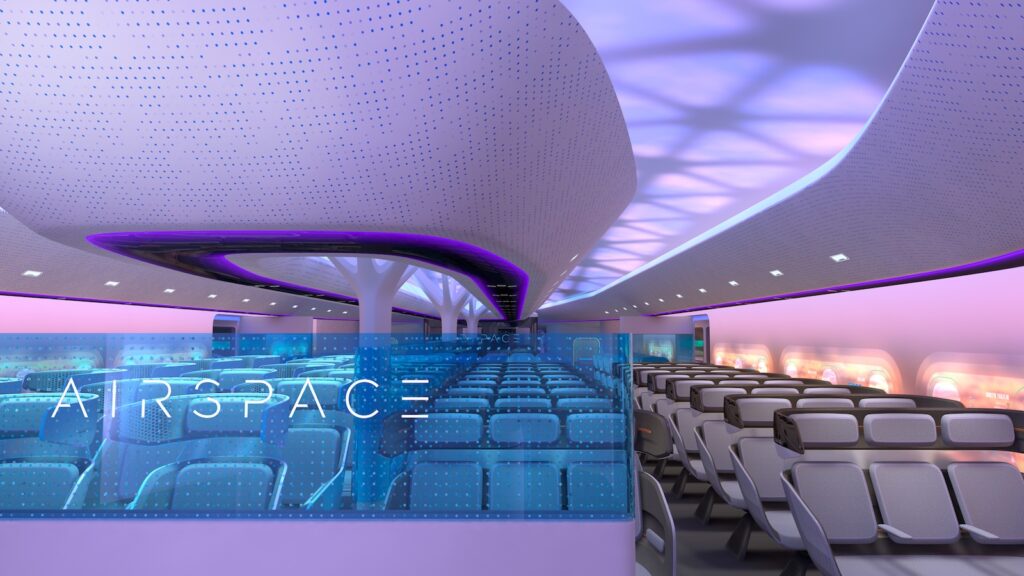
This does not mean that a BWB must perform worse in this respect. However, its unusually wide cabin geometry places different requirements on seating areas, aisles and emergency exits.
Engine Integration: Opportunity and Risk
A BWB also offers additional possibilities for engine placement. Engines can, for example, be positioned on the rear centerbody. This can potentially provide aerodynamic benefits and allow the airframe to shield part of the engine noise.
Wind-tunnel investigations of the Flying-V at TU Delft illustrate how sensitive such integration can be. The tests identified significant interactions between the wing and engine nacelle. At higher angles of attack, additional interference drag occurred, while distorted flow was also measured at the engine inlet.
Engine integration is therefore neither automatically an advantage nor a disadvantage. Engine location and design become part of the overall aerodynamic optimization.
The Airport Also Has to Fit the Aircraft
The practicality of a BWB is not determined in the air alone. The broad airframe can affect refueling, deicing, baggage handling, maintenance and parking positions.
DLR investigated such issues in its Airport 2030 project. For the BWB studied, several ground-handling processes would have required adaptations, although DLR concluded that large parts of the existing airport infrastructure could in principle continue to be used.
Wingspan, ground clearance, doors and system access therefore become additional design constraints that have to be considered from the outset.
How Large Could the Advantage Actually Be?
The 2024 ICAS study provides another useful indication. The aircraft investigated were designed for the same mission: 225 passengers, a range of 5,000 nautical miles and, initially, identical engines.
In this model calculation, the BWB achieved a lift-to-drag ratio around 17 to 18 percent higher in cruise — in other words, a more favorable ratio between generated lift and aerodynamic drag. Fuel consumption over the design mission was around 20 percent lower than for the composite tube-and-wing aircraft and 24 percent lower than for the metallic reference aircraft.
In this particular study, a clear advantage therefore remained even at overall aircraft level. However, the magnitude of that advantage depends heavily on what is being compared, including structural technology, mission, engines and the specific aerodynamic design.
Why Aren’t We Flying in BWBs Yet?
Research over the past decades has reduced many of the fundamental doubts surrounding the BWB configuration. The X-48 demonstrated that such an aircraft can be controlled at low speeds. MAVERIC, the Flying-V and further research programs show relevant aerodynamic and systems-level potential. Comparative studies also suggest that advantages can remain even when structural weight and the overall mission are taken into account.
Nevertheless, the BWB has yet to become an obvious successor to the conventional commercial aircraft. Its broad pressurized cabin requires different structural solutions, engine integration introduces new interactions, cabin and evacuation concepts have to be reconsidered, and airport operations impose additional constraints.
The conventional tube-and-wing configuration has one important advantage: it has been optimized technically, industrially and operationally over many decades. With a BWB, many solutions still have to be developed, coordinated with one another and subsequently demonstrated for commercial operations.
Whether the concept ultimately succeeds may therefore depend less on whether a BWB can fly at all. The key question is whether future programs can demonstrate that its advantages remain intact in a complete commercial aircraft and in real-world operations. This is precisely why JetZero’s planned full-scale demonstrator is likely to attract particular attention.